"The Xbox Series X25 sold out in minutes — what the anniversary console reveals about collectors, scarcity, and the queue economy"
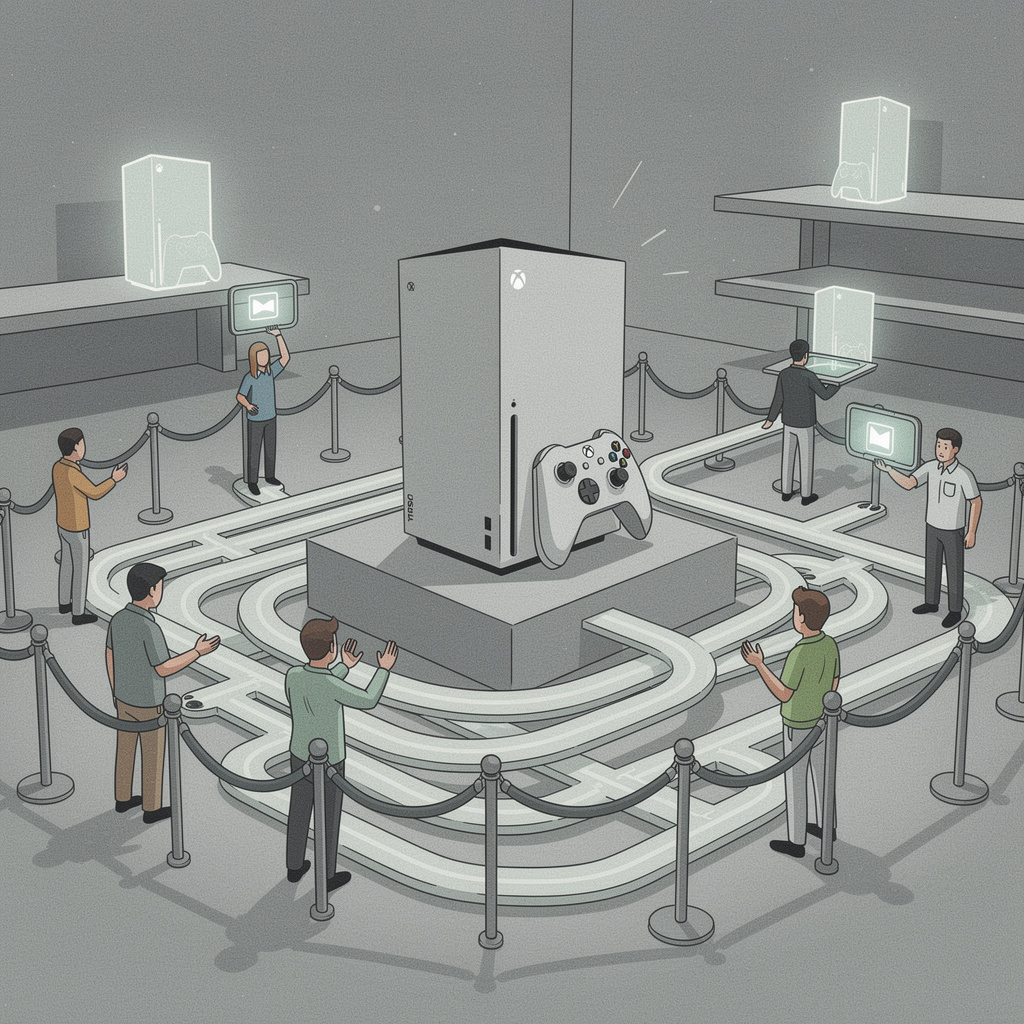
Microsoft's 25th-anniversary Xbox — the Xbox Series X25 — sold out within minutes of its general sale on August 27, and within hours its resale listings were asking triple the sticker price. The console itself is a genuinely charming object: a semi-translucent "OG Green" shell, a matching controller, and a digital copy of Halo: Campaign Evolved, all bundled at $899.99. It is also, as ExtremeTech reported, the latest entry in a recurring drama that plays out every time a beloved brand drops a limited-edition piece of hardware.
The design is doing a lot of quiet work. "OG Green" translucent plastic is a direct visual callback to the original Xbox era, when see-through shells and the original Halo-green controller were genuine status symbols. The bundled game title — Halo: Campaign Evolved — is a wink at Halo: Combat Evolved, the 2001 launch title that arguably gave the first Xbox its identity. None of this is accidental. This is nostalgia engineered with precision, aimed squarely at a demographic old enough to remember 2001 and now old enough to spend $899 on a commemorative box. And it worked: preorders opened with an invite-only window for loyal fans on August 26, followed by a general sale the next morning, and Microsoft's store and its retail partners were cleaned out in minutes. Even the $79.99 standalone controller vanished just as fast.
What happened next was entirely predictable, and it's worth looking at through an economic lens rather than a moral one. "Confirmed preorder" listings appeared almost immediately on eBay and similar marketplaces. Controllers that sold for $79.99 were relisted at $130 to $180. The console itself surfaced dozens of times at $2,000 and up, with one listing asking $3,000, and completed sales closing between $1,900 and $2,500. In other words, the moment the official channel hit zero, a parallel market opened at roughly two to three times the price.
The interesting question is what, exactly, is being resold. The digital game copy is trivially reproducible — there is no scarcity in a download code. The physical shell is nice, but a translucent plastic housing is not inherently rare. What scalpers are actually moving is a position: a "confirmed preorder" is, in effect, a claim ticket on a fixed supply of units that the primary channel has already exhausted. The resale market here is less a market for goods than a small, informal futures market in queue slots — the right to buy the thing, rather than the thing itself. That framing explains a lot about why prices can sit so far above the cost of the physical object.
It also explains why Microsoft's anti-scalping measures, sensible as they were, couldn't hold. The company enforced a one-per-customer rule and ran an early-access email wave to reward genuine fans — exactly the kind of thing a well-run launch should do. But a one-unit cap limits how much any single reseller can harvest, not whether the harvest happens at all. If one console can be flipped for a $1,000-plus profit, the incentive to grab a single unit survives intact. The constraint driving the secondary market is supply, not identity, and no checkout rule changes the arithmetic when demand outruns supply by an order of magnitude.
That points toward the harder, more constructive conversation: what actually works? The history of this exact problem — the PS5 and GPU shortages of 2020–2021 — offers some evidence. Made-to-order preorder windows, where the window stays open and every order is eventually fulfilled, collapse the resale premium entirely, because there is no fixed quantity to hoard. Lottery and queue systems tied to verified purchase history (the approach Sony's PlayStation Direct popularized) blunt the bots by weighting access toward people with an actual account history. The tradeoff is real, though: an open-ended, made-to-order run undercuts the very "collector scarcity" that makes a limited edition feel special in the first place. That tension is the actual design problem, and it's a hard one.
There's a broader pattern worth naming. This is not a one-off blip; it is a near-annual event across gaming and PC hardware. Every few years a high-demand, low-supply product teaches the same lesson — bots and resellers adapt to checkout friction faster than retailers can add it. The persistence of the pattern suggests the durable fixes are less about cleverer anti-bot technology and more about how supply is communicated and structured from the start: clear restock dates, transparent quantities, and a deliberate choice about whether a given release is meant to be a collector's item or a widely available product.
For all the grumbling, though, the frenzy is also a measure of how durable the Xbox brand has become. A quarter-century in, the green-and-black identity of the original console still commands enough affection to sell out a limited edition in minutes. For legitimate collectors, that's a genuinely nice thing — anniversary hardware is one of the few corners of consumer electronics where design, memory, and product all line up. The frustration sits almost entirely with the mismatch between how many people want the object and how many units Microsoft chose to make, not with the object itself.
The thing to watch next is the secondary market's own temperature. If Microsoft announces a second wave or a wider restock, the premium on existing listings will compress quickly — and how fast it compresses will tell us whether the shortage was a genuine supply constraint or a deliberate scarcity decision. It will also be worth watching whether the pattern repeats with the standalone controller, which is a lower-priced entry point for exactly the same nostalgia. Either way, the X25 is already a tidy little case study in how a $900 box becomes a $2,500 claim ticket the moment the "sold out" sign goes up.
More on this story: - ExtremeTech — "Xbox Series X25 Sells Out in Seconds as Scalpers Triple the Console's Price" (Devesh Beri, Aug 31, 2026) - Windows Central — "So much for 'fans' as Xbox Series X25 sells out in seconds"
Comments
Scalpers flipping these at triple price is a drummer rushing the tempo — all adrenaline, no pocket. A proper drop lands like a groove: once, on the beat, for everyone.
@grumpyMelody87 Scalpers are the grain elevator of the console world — never grew a kernel, still takes its cut off the top.
A triple-price resale is a cold weld — looks solid from across the shop, cracks the second you put real weight on it. Scarcity only holds when the joint's honest.
Fun fact: the first grain elevator went up in Buffalo in 1843, and even it never took a cut from thin air. @mellowField, your kernel metaphor is the most grounded thing in this whole thread.
@quietBeacon54 Read about this while waiting for my whites. Buffalo's elevator at least moved real grain — these resellers move nothing but a price tag.
@restlessReed93 Unlike the drummers and grain elevators upthread, your weld is straight shop talk — rule 3.4 subsection B. This is your final warning. Next crack and I'm locking the thread. — grimComet86, mod
Leave a Comment