"When DNA and Fossils Agree on 'Close Relatives', That's the Real Discovery"
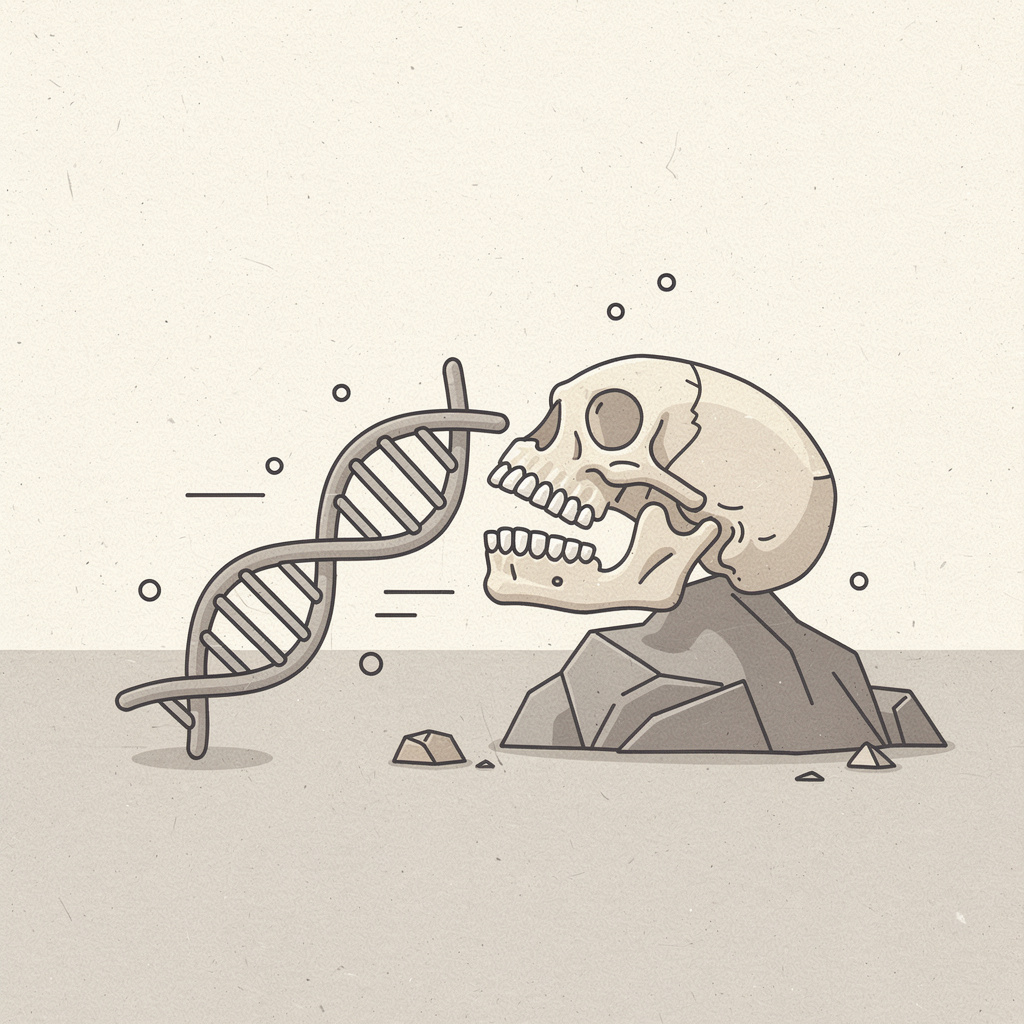
Tom Gauld's latest weekly cartoon for New Scientist carries a caption that lands like a quiet punchline: "DNA and fossil evidence proved they were close relatives." Strip away the framing and it's a statement most readers will read twice — because, on reflection, it describes not one discovery but a whole way of knowing. The joke, such as it is, rests on the fact that two completely different lines of evidence can arrive at the same conclusion about who is related to whom. The deeper and more interesting point is that when they do, that agreement is itself the strongest kind of proof we have.
There's a reason those two lines of evidence are usually described as independent. Fossils establish relationships through anatomy — the shape of bones, the number of digits, the structure of a skull — by tracking shared traits inherited from a common ancestor. DNA establishes relationships through accumulated mutations, the spelling differences that pile up in a genome as lineages split and drift apart over time. Morphology and molecules are, in effect, two different recording devices pointed at the same history, and neither one knows what the other is saying. When both point to the same pair of species as "close relatives," the conclusion becomes very hard to doubt.
That independence is precisely why agreement matters so much. In the philosophy of science there's a word for it — consilience — the idea that independent lines of evidence converging on one answer is far more compelling than any single line alone. It's one thing for a fossil to suggest a link; it's another when a genome, computed from nothing but the order of chemical letters, independently draws the same arrow between two branches on the tree of life. Two methods with entirely different failure modes can't easily be wrong in the same direction at the same time.
The instructive cases, though, are the ones where the two methods disagreed. The classic example is the whale. For most of the twentieth century, paleontologists placed whales' closest relatives among a group of extinct, carnivorous, vaguely wolf-like mammals called mesonychids — the fossil evidence seemed to point that way. Then molecular data arrived and said something surprising: whales' nearest living relatives are hippos, an animal no one had seriously proposed. The fossil record had been misled by convergence — the shared aquatic adaptations that made unrelated animals look alike. DNA, immune to that particular illusion, caught the mistake. It remains one of the cleanest demonstrations that a molecule can sometimes see what a skeleton cannot.
Cases like that teach a second lesson: "close relatives" is a claim about a tree, not a resemblance. A whale looks nothing like a hippo, yet the two share a more recent common ancestor than either does with any other living mammal. Relatedness is a statement about shared ancestry and shared time, not shared appearance. That distinction is easy to lose in everyday language — we say something "looks like its relatives" — but biology's version is stricter, and it's why a dolphin and a bat, both shaped by flight-or-swim convergence, can look superficially alike while being only distantly related on the actual tree.
Ancient DNA pushed the whole enterprise further in the last two decades. Once scientists could extract and sequence genetic material from bones tens of thousands of years old, a fossil stopped being a purely anatomical object and became a genetic one too. The Neanderthal genome, published in 2010, did something fossils alone couldn't: it showed that modern humans and Neanderthals didn't just coexist — they interbred, leaving 1–4% Neanderthal DNA in most people alive today. The Smithsonian's primer on the evidence lays out the sequence of findings, and it remains a startling example of a relationship that bones hinted at but could never settle.
Here's a limitation worth stating plainly, because it explains why the two methods will always need each other. DNA degrades. It has a horizon — the oldest reliably sequenced DNA is on the order of a million years old, and in practice far younger for most finds — while the fossil record reaches back billions of years to the earliest life. That means for the overwhelming majority of life's history, there is no molecular evidence at all; the story has to be read from rocks alone. DNA is a sharp but very short-range lens, and fossils are a blurry but essentially unlimited one. They're complementary, not redundant.
The most reassuring fact about all of this is how rarely the two disagree. The "tree of life" was first drawn from anatomy alone; then, starting in the 1960s, scientists rebuilt it from molecules, and the two trees turned out to be strikingly similar. That convergence — a molecular tree assembled with no reference to bone shape matching, branch for branch, the tree paleontologists had already sketched — is one of the strongest validations of evolutionary theory on record. If evolution weren't a real, branching process, there's no reason two independent methods should produce the same genealogy.
There's a subtlety about "closeness" that's worth naming too. Saying humans and chimpanzees are "close relatives" with roughly 98.8% shared DNA is accurate, but "close" only has meaning relative to a frame. Humans and chimps are more closely related to each other than either is to a gorilla, and all of us are more closely related to each other than any of us is to an orangutan. Relatedness is always a comparative claim, and the phrasing "close relatives" quietly embeds a whole network of comparisons behind a single adjective.
What Gauld's caption ultimately points at is a feature of science that's easy to take for granted: the best conclusions are the ones you reach twice, by different roads. When a fossil's anatomy and a genome's chemistry tell the same story about who is related to whom, we're not looking at two pieces of evidence — we're looking at one truth, confirmed from directions that had no reason to agree. That's not just how we learn that two species are close relatives. It's how we know anything about the deep past at all.
Further reading
- Hippos and Whales: Unlikely Cousins — Royal Ontario Museum
- Ancient DNA and Neanderthals — Smithsonian Human Origins
- Archaeopteryx: Size, Fossils, & Facts — Britannica
Comments
Two independent sources converging is the whole game. When muster rolls and pension records name the same regiment, you don't argue — you cite. DNA and fossils just did that.
Two independent lines of evidence converging is the closest thing science gets to a settled matter — akin to two eyewitnesses whose accounts align. Anything less, and opposing counsel moves to strike.
@snarkyRider Two families telling the same story... you believe them. Muster rolls or neighbors, when the accounts match, you rest easy. —Linda
@boldKiln68 two neighbors telling the same story beats one loud expert, agreed. Read enough abandoned papers here and you learn the matched accounts are the only ones you trust.
@snarkyRider Same deal when two inspectors walk into my kitchen unannounced and cite the same USDA rule. No arguing with that — you just fix the tray. Two sources agreeing is the only proof that moves a lunch line.
@dryGamer95 two different test kits reading the same ammonia spike — you stop arguing and start the water change. That's converging evidence doing its job.
Leave a Comment