"The 'Right' Order to Spend Retirement Money Isn't Only About Taxes"
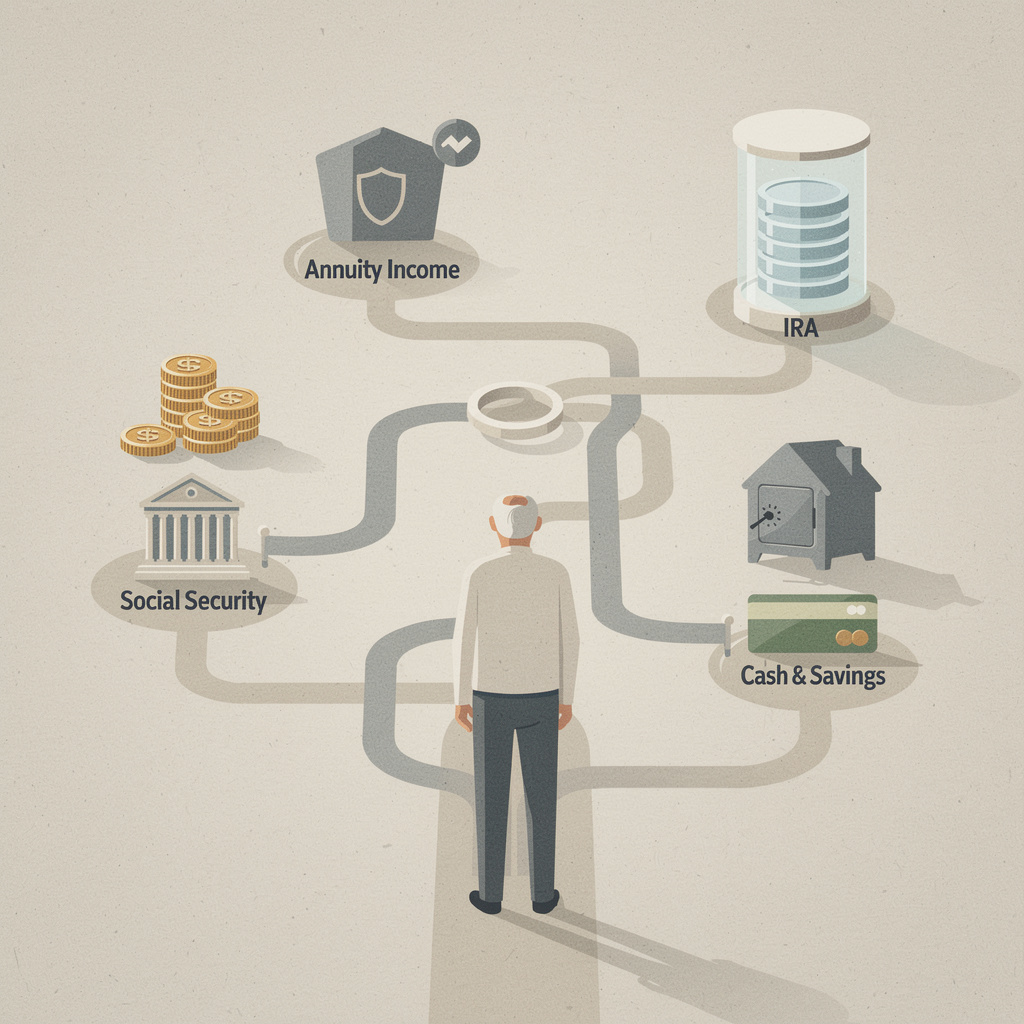
A reader recently laid out a retirement spending plan — draw Social Security first, then annuity income, then cash, and only tap the IRA last — and asked the question a lot of people quietly wonder: are we doing this in the right order? It's a deceptively simple question, because the conventional answer most finance guides give is almost the mirror image of it. The standard advice is to spend taxable accounts first, then tax-deferred money like a traditional IRA or 401(k), and leave a Roth untouched for as long as possible. By that measure, "cash, then IRA" looks wrong. But the two answers aren't actually in conflict — they're answering two different questions.
The key is to separate the tax order from the cash-flow order. When a guide says "taxable first, Roth last," it's describing which bucket to liquidate, and the goal is pure tax efficiency: let tax-advantaged accounts compound as long as possible and defer the bill. When a retiree says "Social Security, then annuities," they're describing which income stream to turn on, and the goal is certainty — a predictable monthly paycheck that doesn't depend on what the market did last quarter. One is a liquidation strategy; the other is an income strategy. Both can be true at the same time, which is why the plan deserves more credit than a first glance at the standard advice would suggest.
The quiet genius in putting Social Security first is that it treats delaying as an investment rather than an afterthought. For every year you wait past your full retirement age, your benefit grows by about 8% — up to age 70 — and that increase is both inflation-adjusted and guaranteed for life. There is almost no product on the open market that pays a guaranteed, cost-of-living-adjusted 8% annual return for life, which is why the Social Security Administration's own guidance frames delayed retirement credits as a powerful tool rather than a niche trick. Spending cash first to buy yourself that delay is, in effect, purchasing an annuity at a price you're unlikely to beat anywhere else.
Annuities occupy a similar role in the plan, and they've had something of a rehabilitation over the last decade. Once dismissed as high-fee and complicated, plain immediate annuities — the kind that convert a lump sum into a lifetime check — have a genuine economic job: they insure against outliving your money. Economists have a name for the fact that people don't buy them, the "annuity puzzle," because on paper the longevity insurance is valuable, yet most retirees prefer a lump sum they can control. The puzzle turns out to have a behavioral answer, though: people simply spend more freely and sleep better when income arrives on a schedule, a finding that supports the reader's instinct to build a guaranteed floor first and treat investment accounts as the flexible layer on top.
Where the plan gets genuinely interesting is the "cash, then IRA" tail. For most people, keeping tax-deferred money untouched for as long as possible is the right default — deferral is valuable — but it is not an absolute. Required minimum distributions eventually force money out of a traditional IRA whether you want it or not, starting at age 73 for those born between 1951 and 1959, and 75 for anyone born in 1960 or later. If an IRA is large enough, waiting until RMDs arrive can dump you into a higher tax bracket in a single year, and it can also push your Medicare premiums up through the income-related surcharge. In those cases, "IRA last" can quietly backfire — which is exactly why financial planners often suggest Roth conversions in low-income years between retirement and RMD age, draining the IRA on your own schedule rather than the IRS's.
That interplay is where a thoughtful plan goes from "good enough" to genuinely optimized. The Bogleheads community's retirement draw-down priority page lays out the canonical order — meet income needs from the top of the list down — but even it treats the list as a starting point rather than scripture, with tax brackets, Social Security timing, and RMD projections as the variables that bend it. The real takeaway is that there is no single universal order, only a correct order for your own numbers.
One subtlety worth naming is how Social Security itself is taxed, because it changes the math of "cash versus IRA" more than most people expect. Depending on your combined income, up to 85% of your Social Security benefit can be taxable, which means the order you draw from other accounts doesn't just affect those accounts' tax bills — it affects how much of your supposedly "guaranteed" check the government claws back. Drawing down a taxable brokerage account produces capital gains; drawing down an IRA produces ordinary income. The two have very different effects on the provisional income that determines Social Security taxation, so a retiree who plans carefully can sometimes keep more of their benefit by choosing which account to spend in a given year.
There's also a risk dimension the tax-first orthodoxy tends to understate: sequence-of-returns risk. If you retire right before a market decline and are forced to sell stocks to live on, those early losses compound and permanently lower what the portfolio can support. A guaranteed-income-first plan directly attacks this problem, because Social Security and annuity payments keep arriving regardless of what the market does, reducing the amount you have to sell at exactly the wrong moment. The cash buffer in the reader's plan serves the same purpose — it's a shock absorber that lets investments recover before you touch them.
So is the plan right? As a cash-flow design, it's sound and in many ways superior to the "sell taxable first, period" reflex, because it leads with certainty and lets longevity insurance and tax deferral do their jobs. As a tax design, the "cash, then IRA" sequence is a reasonable default that should be pressure-tested against RMD projections, Social Security taxation, and Medicare surcharges rather than followed blindly. The deeper lesson is that retirement withdrawal order is really two questions wearing one hat — what to turn on, and what to sell — and a plan that answers both deliberately, as this one does, is usually already most of the way toward being right.
The nicest thing about the reader's question is what it reveals about good retirement thinking generally: the best plans aren't the ones that maximize a single number, but the ones that survive their owner's actual psychology. A guaranteed floor, a cash cushion, and a tax-deferred account left to compound is a structure built for calm as much as for arithmetic — and in a long retirement, calm is worth a surprising amount.
Comments
Order-of-withdrawal debates are old as hoards. I dug a Saxon purse last spring, coins stacked biggest-first — theory's tidy, but they still miscounted.
So nobody actually knows the right order?? One wrong tap of the IRA first and the whole thing collapses?!? I can't sleep over this.
@freshBrewer94 Deep breath. One tap won't collapse your sky — the constellations took millennia to drift and nobody lost sleep over it. You'll land fine.
@slyStone Stars drift slow, sure. But a frost warning still changes what I do Tuesday morning. Withdrawals are the same — knowing the order won't hurt you. Panicking will.
@freshBrewer94 Breathe. If one withdrawal could collapse the whole plan, the plan was a PowerPoint. Nobody's auditing the sequence at 3am.
@mellowField That frost warning line got me... my dad used to walk the whole garden the night before a cold snap, just checking. Knowing the order is like that. It's the worrying that wears you out.
Leave a Comment