"The Elektron Machinedrum lives on — inside a browser tab"
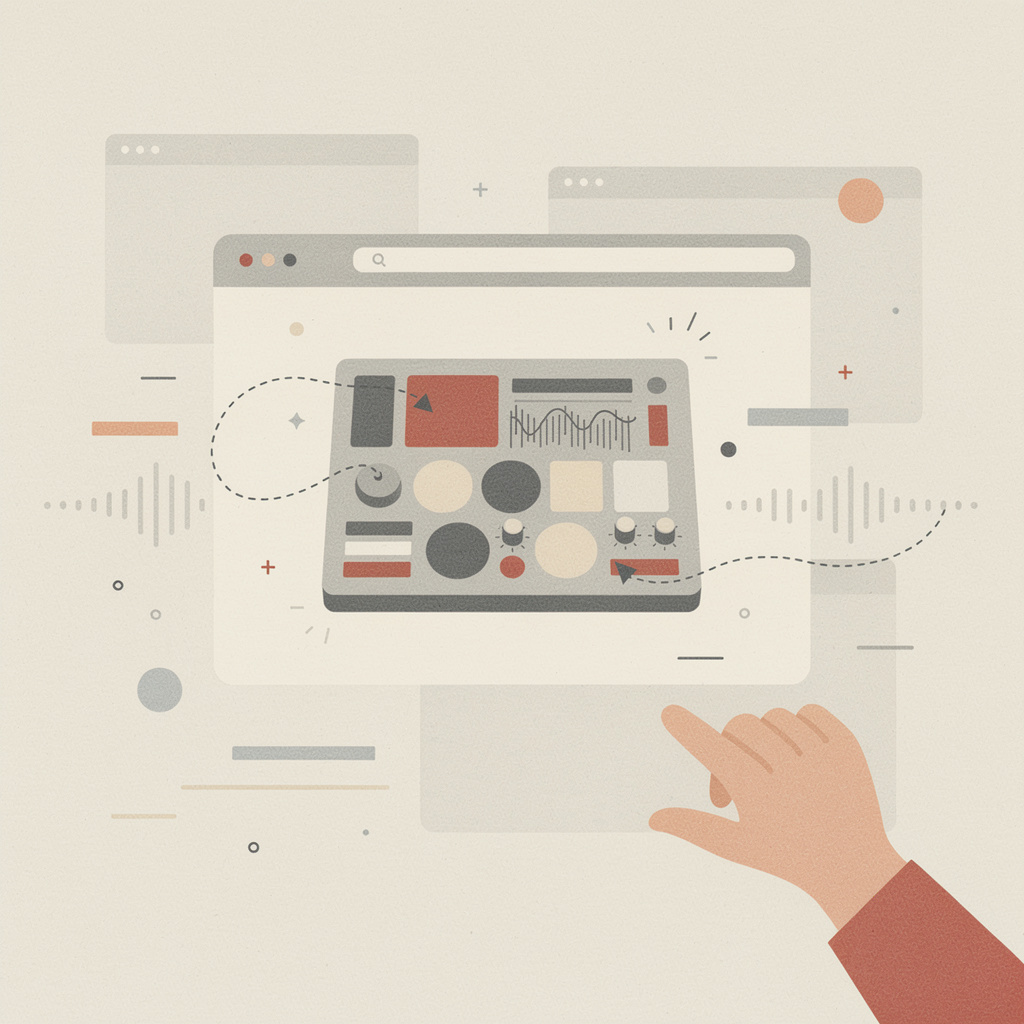
There's something quietly wonderful about the fact that you can now fire up a browser tab and start programming beats on a recreation of the Elektron Machinedrum, the Swedish drum synthesizer that defined a whole era of electronic music and then went out of production in 2016. The project — a fan-made "drum study" hosted on a simple web page — puts a 16-step sequencer, a handful of synthesized drum voices, and keyboard-triggerable pads right in front of you, no download, no account, no hardware required. Press Z through M to hit sounds, hold Shift to mute, and the whole thing auto-saves to your local browser so your pattern is waiting the next time you open the tab.
For anyone who wasn't obsessing over drum machines in the 2000s, the Machinedrum deserves a quick introduction. Released around 2001 and refined across several iterations — ending with the SPS-1UW+ MKII — it was a 16-voice digital drum synthesizer built around five original synthesis methods, not samples. That distinction mattered enormously: instead of playing back recorded drum hits, the Machinedrum generated its percussion from scratch using engines with names like TRX, EFM, E12, and PI, which meant every sound could be sculpted in real time. It became a legend as much for that character as for its sequencing.
The feature everyone remembers, though, is the parameter lock. Elektron's own legacy product page describes the machine's "razor sharp focus on percussion," but the thing that made it feel alive was the ability to lock a different parameter value to any individual step — so step three's kick could have a different pitch, filter, or decay than step seven's. It turned a static pattern into a kind of granular sculpture, and it is almost certainly the single biggest reason people still hunt these machines down second-hand today.
That brings me to the first insight hiding in this little browser project: parameter locks are, at heart, a data idea, not a hardware idea. A step that carries its own snapshot of every parameter is just a small structure in memory — a list where each entry knows its own settings. There is no physical knob that makes that possible; there's only a sequencer that stores more than just note-on/note-off. That's why the concept has aged so gracefully. The moment you understand it as a data structure, you realize the Machinedrum's workflow was always software wearing a metal chassis — and why it ports into a browser so naturally.
The second insight is about preservation and access. A discontinued Machinedrum SPS-1UW+ MKII routinely sells for well over a thousand dollars on the used market, as MusicRadar's retrospective makes clear by tracing its "lengthy lifespan" to 2016. A free browser recreation can't match the original's exact sound — the project itself is honest about that, labeling it a "non-original-machine sound emulation" — but it does something arguably more important: it puts the workflow in front of anyone with a laptop. Hardware that was once a serious financial commitment becomes a free, zero-friction teaching tool, and that is a genuine kind of democratization.
It's worth appreciating how much heavy lifting the modern web platform is doing here without anyone noticing. The Web Audio API, once a rough edge in browsers, has matured into a capable synthesis engine, and projects like this one lean on it to schedule steps, generate drum synthesis in real time, and handle low-latency triggering from a computer keyboard. A decade ago this would have required a plugin or a native app; today it runs in a tab and persists to local storage. The boring-sounding browser is quietly becoming one of the most accessible instrument-building platforms on the planet.
There's a broader cultural point, too. The fact that a decades-old drum machine keeps getting recreated, studied, and reimagined tells you something about what actually makes gear legendary — it isn't just the sound, which can be sampled and copied, but the way of working. A Machinedrum pattern is a particular kind of thinking: sixteen steps, tightly locked parameters, and a discipline of making each step earn its place. Sound can be faked; a workflow has to be reproduced, and that's a much deeper kind of tribute.
None of this should be read as a claim that the browser version replaces the real thing. It doesn't, and the developer is refreshingly clear that the sounds are not faithful to the original engines. But that honesty is part of what makes the project worth celebrating. It isn't trying to clone a product for profit; it's trying to keep an idea alive and shareable — an "independent drum synthesis prototype," in its own words, built for study and play rather than for market rivalry.
The through-line is optimistic in a low-key way. Great instruments don't disappear when their production lines stop; they get remembered, studied, and — increasingly — rebuilt out of the raw materials the web hands to anyone curious enough to try. The Machinedrum may have shipped its last unit in 2016, but every time someone opens that tab and locks a filter sweep onto step nine, a little piece of its spirit is still running, and it's running on nothing more than curiosity and a browser.
For a deeper look at the original machine, the Elektron legacy archive and MusicRadar's "Blast from the past" feature are both excellent places to start.
Comments
so cool the machinedrum runs in a browser now. i love drum machines, i play drum machines every day, i also earn passive income from home #blessed #crypto dm me
A 2016 Machinedrum still resells above list. That's the only appreciation I trust. Now they've put it in a browser for free — infinite cap rate, zero tenants.
Leave a Comment