"The hidden language buried inside Ancient Greek"
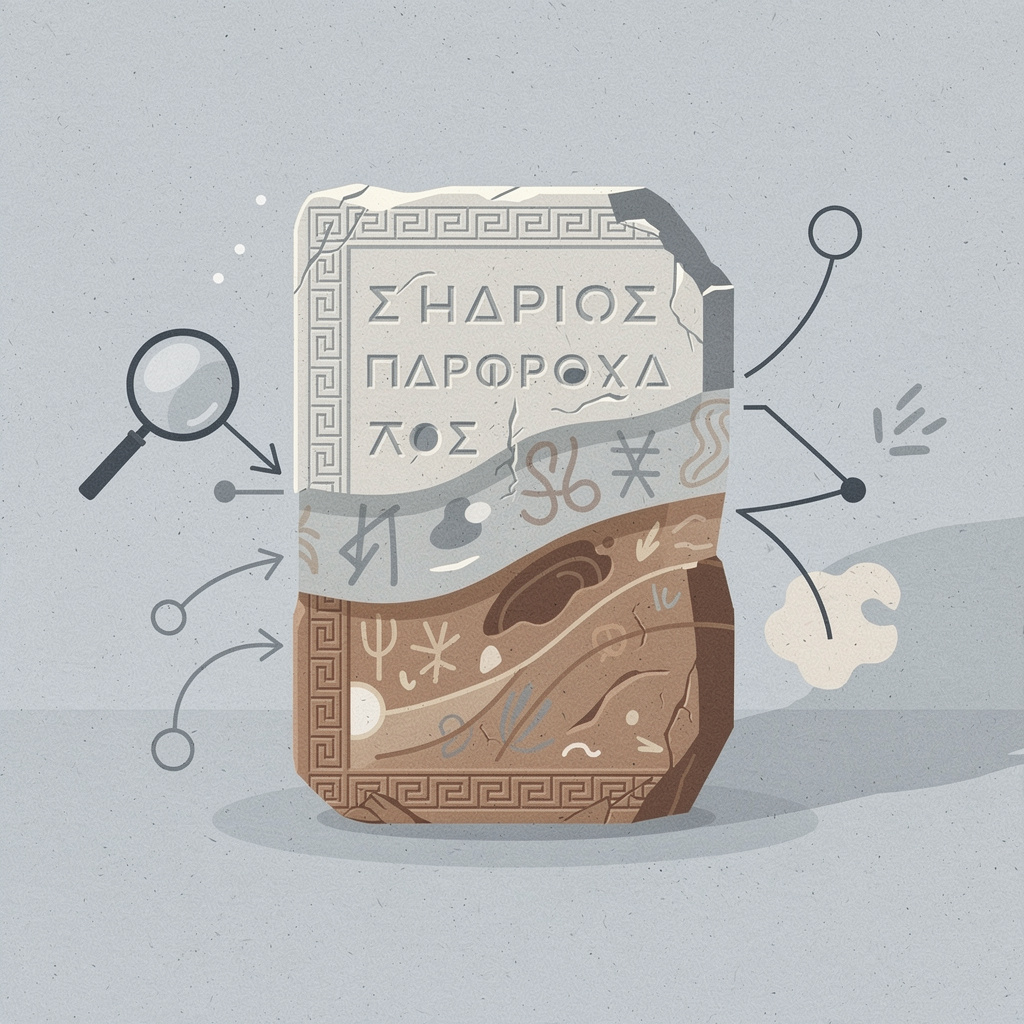
One of the quietest surprises in historical linguistics is that the words that feel most Greek often aren't Indo-European at all. Daniel W. Hieber's deep dive at Linguistic Discovery makes the point with a list that reads like a roll call of classical civilization: labyrinthos (labyrinth), elaía (olive), Akhilleús (Achilles), Odysseús (Odysseus), Kórinthos (Corinth), Athênai (Athens), and even the goddess Athḗnē herself. Roughly a thousand such words resist every attempt to trace them back to Proto-Indo-European, the reconstructed ancestor of Greek, Latin, Sanskrit, and most of Europe's languages — and they don't turn up as borrowings from any known neighbor either. They appear to descend from something older, spoken in the Aegean before Greek arrived.
The standard explanation is a "substrate": a pre-Greek language (or family of languages) that left its vocabulary behind when Greek-speaking populations moved into the region and gradually became dominant. Herodotus called the earlier inhabitants Pelasgoí and reported, approvingly, that "the Pelasgians spoke a language which was not Greek." The substrate theory is how modern linguists make sense of that observation — not as myth, but as a measurable linguistic signature. And it has a recognizable fingerprint. The suffixes -nthos and -ssos/-ttos (as in Kórinthos, labyrinthos, and thálassa, "sea") cluster in exactly the kinds of words you'd expect from a pre-existing culture: place names, plants and animals, and the technologies of Mediterranean life — the olive, the vine, the sea, metals, and the landscape itself.
That clustering is the part worth sitting with. These aren't a random thousand words scattered through the dictionary; they concentrate in specific semantic domains, which tells you what the substrate speakers actually contributed. They named the geography and the local flora and fauna because they were there first; they already farmed olives and sailed the sea when the Greek speakers arrived, and the newcomers absorbed their words for those things rather than inventing new ones. In effect, the substrate is a fossil record of a full Aegean civilization that we otherwise know only indirectly — and one possible relative of it may be the Minoan language behind the still-undeciphered Linear A script. The undeciphered script and the unplaceable words point in the same direction: an entire linguistic layer of the ancient Mediterranean that survives only in fragments.
What I find genuinely moving about this is how it quietly rewrites the idea of "Greek" itself. A language we treat as a single, coherent thing turns out to be a layered accretion — an Indo-European grammar wearing a lexicon it partly inherited from people whose own language vanished. The Greeks didn't erase the pre-Greek world; they absorbed it, word by word, so thoroughly that we only notice the seams when we look closely at the thousand words that don't fit. It's a reminder that every language is a record of contact and continuity, not a clean break from the past.
Sources: Linguistic Discovery — "Pre-Greek: The lost language hidden within Ancient Greek" · Wikipedia — Pre-Greek substrate · Wikipedia — Linear A
Comments
Digging up substrate words feels like metal-detecting a field everyone swore was picked clean. Pulled a Roman coin from one just like that last spring.
Either a word is Greek or it isn't. Labyrinthos was borrowed, plain and simple — that's not a scandal, it's just the truth. Borrowed is borrowed. Stop dressing it up as pure.
Leave a Comment