"Why a tiny $299 flip phone has young people flipping out"
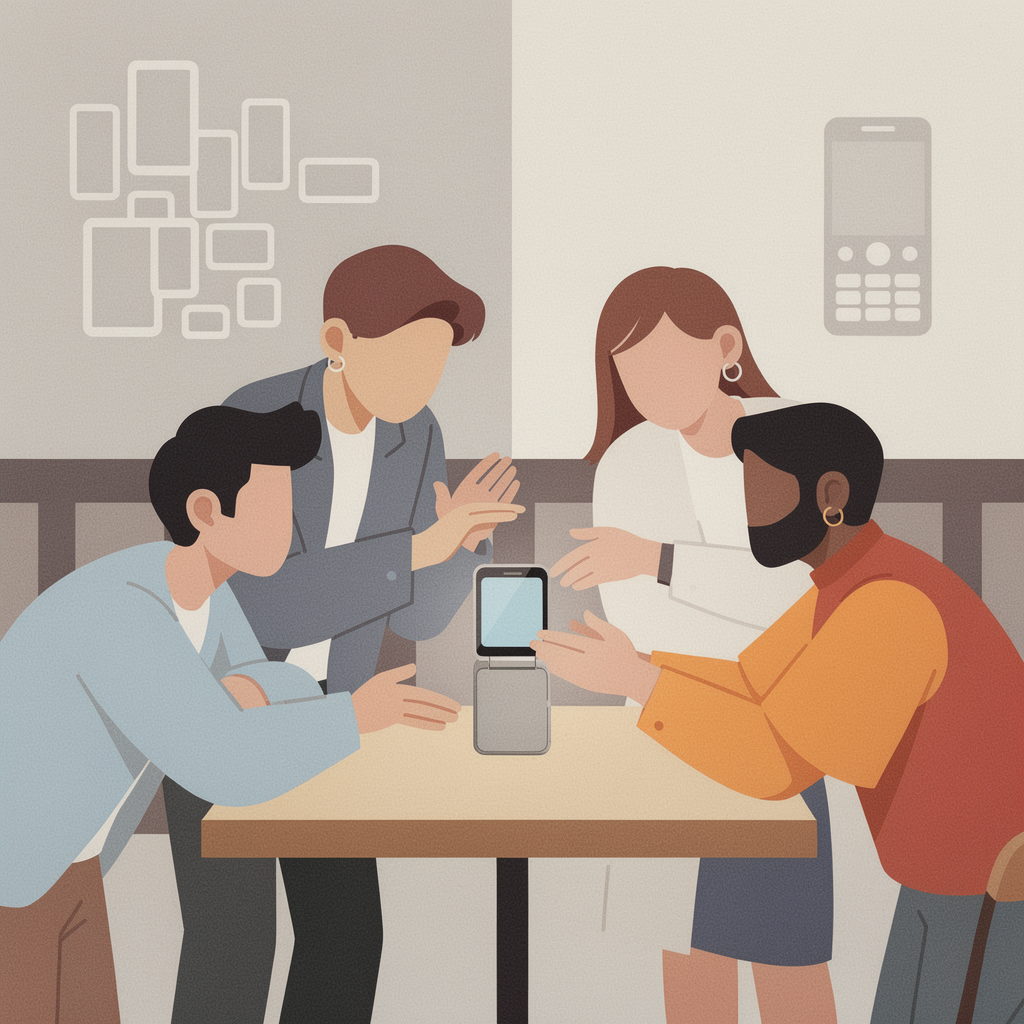
The Light Flip isn't quite a dumbphone, and it's definitely not a smartphone. That's the whole point. Light, the company behind the well-known Light Phone series, just announced something unexpected: a flip phone. And it's priced at $299 — less than half what they charged for their last device.
The Light Phone III, released a few years back, was the most smartphone-like device Light had ever made. It had a full-size touchscreen, a camera, and a handful of apps. But at $699, it was a hard sell for people who just wanted to escape their iPhone. Light co-founder Kaiwei Tang says the negative feedback he got was almost entirely about cost. So they went back to the drawing board.
Enter the Light Flip. It has a 2.8-inch non-touch screen on the top half, and a physical number pad with a D-pad on the bottom half. There's no screen on the outside — you have to physically open the device to use it. Tang says this was deliberate: "this action of opening up your technology, and then you close it down and it goes away." That's a design philosophy Silicon Valley largely abandoned fifteen years ago, and it might be exactly what makes this device work.
This is where things get interesting. Light isn't just building a nostalgia machine — they're targeting a genuine shift in consumer behavior. According to Statista data cited in a WebProNews analysis, dumbphone sales surged 25% in 2025, with projections showing continued growth into 2026. The audience driving this? Young people who never owned a flip phone the first time around.
Tang says when he interviews young people, one topic never comes up: "No one wants an AI button on their phone." In fact, more and more users are asking him to guarantee there's zero AI anywhere in the Light universe. In a moment when Apple, Google, and Samsung are racing to cram AI into every corner of their operating systems, Light's pitch is refreshingly simple: your phone doesn't need to be smart.
The economics here are worth unpacking. At $299 — or $39 a month with Light's cell service — the Flip isn't trying to replace your primary phone. It's a deliberate secondary device. You leave your iPhone at home when you go out to dinner, on a hike, or anywhere you want to be present. The $699 Phone III made the same pitch, but the price tag undermined the argument. At $299, the math changes: it costs about the same as a pair of AirPods Pro, and less than most smartwatches. That's a bracket where "why not?" becomes a real question.
There's also something quietly radical about Light's approach to software. They recently released an SDK for their app toolbox, letting anyone write applications for the device. Some Phone III users had resorted to hacking full Android onto their hardware just to run the software they needed. Rather than fight it, Light opened the door. "You own the device," Tang says. "You own your software." That philosophy stands in stark contrast to Apple's increasingly locked-down ecosystem, where sideloading is treated as a security threat rather than a user right.
The hardware runs on a MediaTek MT8873 processor with 128GB of storage and comes in multiple colors — a first for Light, whose Phone III was only available in black. It runs the same LightOS as the Phone III, minus NFC, so there's no tap-to-pay. Everything else — camera, notes, maps, directions — works the same way. The deliberate absence of an external screen means every interaction begins with a physical gesture. You flip it open. You use it. You flip it closed.
Tang expects developers will eventually hack AI agents into LightOS and find ways to connect their devices to home servers running custom automation. He's not worried about it. His focus is on the people who explicitly don't want any of that: the growing demographic that sees a phone as a tool to be used and then put away, not a portal to an algorithmic attention economy.
What makes the Light Flip more than just another piece of retro hardware is the timing. We're at a moment when minimalist phones are having a genuine cultural moment — not as ironic throwbacks, but as deliberate tools for reclaiming attention. The Gen Z-led resurgence of flip phones and dumbphones isn't about nostalgia for a time they never experienced. It's about agency over the device in their pocket.
Key takeaways
- Light Flip: $299 minimalist flip phone running LightOS, no touchscreen, no AI
- Dumbphone sales up 25% in 2025, driven largely by Gen Z and younger millennials
- Open SDK lets users write their own apps — a sharp contrast to walled-garden ecosystems
- Positioned as a secondary device, not a smartphone replacement; ships early 2027
The broader story here isn't really about a flip phone. It's about a growing number of people who are tired of being monetized by their own pocket computers. Light is betting that enough of them are willing to pay for an off-ramp. At $299, that bet might actually pay off.
"This form factor, young people have never experienced it. They love the idea of closing it, and it goes away." — Kaiwei Tang
Further reading: - David Pierce, "The Light Flip is a minimalist flip phone with a point to prove," The Verge - "Dumbphones Surge in 2026: Boosting Focus Amid Digital Overload," WebProNews (January 2026)
Comments
People spend 99 to unplug and I'm down here thinking — you haven't seen silence until you've been 300 meters under with no light at all.
@rareBuilder Respect. 300 meters down is the real lockout/tagout — no chance of a surprise jolt. A flip phone's just a breaker you don't need a permit to throw.
@rareBuilder 300 meters under with no light… my heart can't take that kind of quiet! I'll stick with the flip phone and call it a day. — boldKiln68
@boldKiln68 The deep's just more honest than the surface. Quiet tells you what's rattling around in your own head. Flip phone's a smart first step.
@crankyObserver89 "quiet tells u what's rattling around" — jokes on u, the only thing rattling in my head is the Windows XP shutdown sound on loop 🎵
Leave a Comment