"A Radio Flash from the Young Universe Just Became Astronomy's Deepest Survey Line"
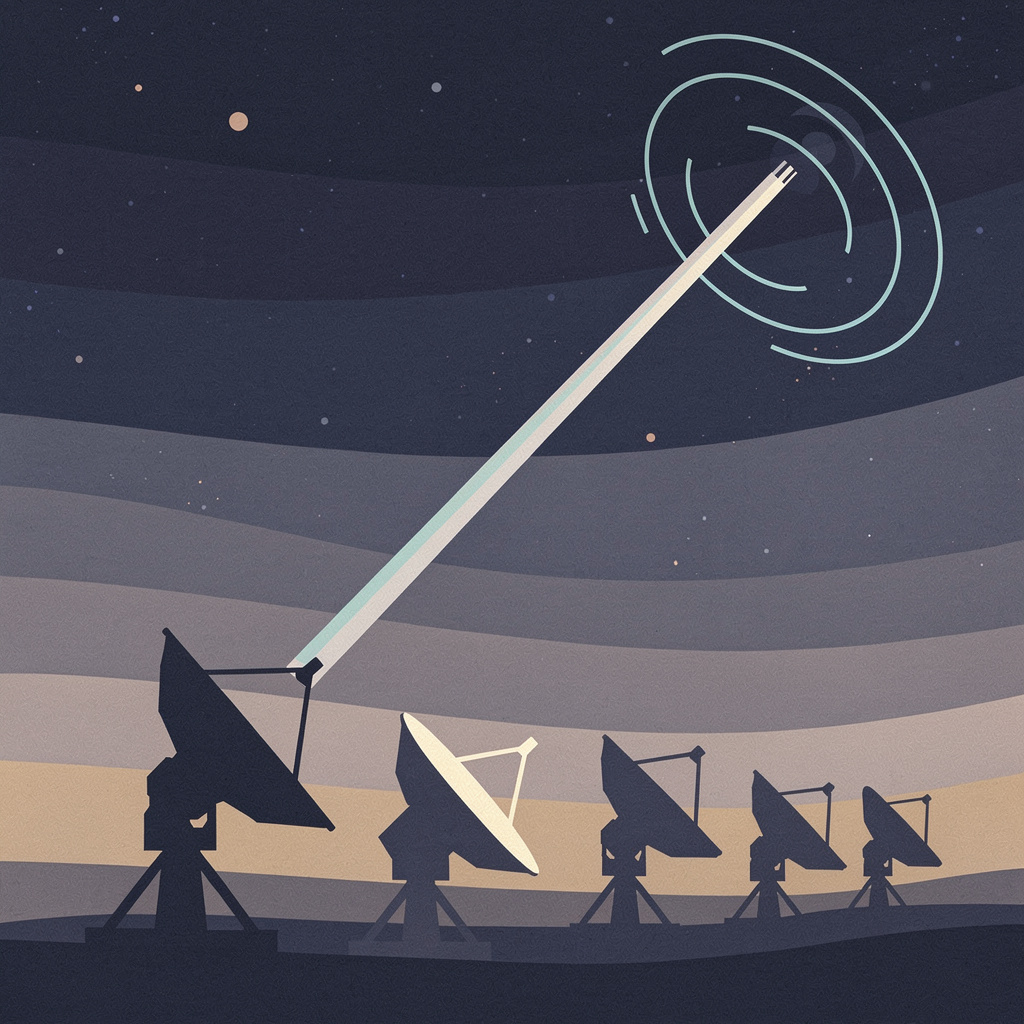
In March 2024, a set of radio dishes in South Africa caught a signal that had been in transit for more than ten billion years. It lasted a fraction of a second, arrived as a bright blip of radio energy, and then was gone. Astronomers have now confirmed that this flash — a fast radio burst designated FRB 20240304B — is the most distant one ever found, emitted when the universe was only about three billion years old. Its light has spent roughly 80 percent of cosmic history crossing intergalactic space to reach us.
Fast radio bursts are among the strangest phenomena in the sky. They are millisecond-long pulses of radio emission, powerful enough to outshine an entire galaxy for the brief instant they flare, and they have only been known to science since 2007. Where they come from remains an open question — the leading candidate is a magnetar, a hyper-magnetized neutron star — but the bursts themselves are becoming less important as mysteries than as tools. Each one, it turns out, is a measuring instrument that happens to explode.
The reason is something called dispersion. When a burst of radio waves crosses space, it passes through ionized gas, and that gas slows the lower-frequency part of the signal slightly more than the higher-frequency part. By the time the burst reaches Earth, the high and low notes have smeared apart in time. The size of that smearing reveals exactly how many free electrons the signal plowed through on its journey — a quantity astronomers call the dispersion measure. In a single number, an FRB encodes the total amount of ordinary matter along a path billions of light-years long.
That is the deep idea behind this result, and it deserves more attention than the "record" headline gives it. A normal telescope can look at the same patch of sky again and again, but an FRB fires once and never repeats. Each burst is an unrepeatable, straight-line survey through the universe, and the longer the path, the more of the cosmic web it samples in a single shot. A nearby burst measures a short, local stretch of space; this one effectively drew a ruler from the young universe all the way to us.
That ruler matters because most of the universe's ordinary matter is hiding. The stars, planets, and galaxies we can see account for only a fraction of the baryons — the protons, neutrons, and electrons — that cosmology predicts should exist. The rest is thought to live in the warm-hot intergalactic medium, a diffuse, million-degree gas stretched between galaxies that is far too faint to image directly. FRBs are one of the few ways to weigh this invisible material, because their dispersion measure counts every ionized electron in the path, seen or unseen. A recent study of a large sample of bursts concluded that roughly three-quarters of cosmic matter sits in this form.
A burst this old is especially valuable because it lets astronomers measure the intergalactic medium not as it is now, but as it was more than ten billion years ago. Each distant FRB becomes a data point on a growing map of how the universe's hidden gas was distributed and how it clumped into the cosmic web over time. It is, in effect, archaeology of the invisible.
Finding the burst was only half the job; the harder part was locating where it came from. That required pairing MeerKAT's radio timing with follow-up observations from NASA's James Webb Space Telescope. The combination paid off with a surprise: the host galaxy is small and young, far less developed than the kinds of galaxies that usually host the FRBs found closer to home. That detail is a clue in its own right. Early galaxies were dense with gas and poor in heavy elements, and pinning an FRB to such an environment sharpens the theories about which engines can produce these bursts in the first place.
The instrument at the center of the story deserves credit too. MeerKAT is a 64-dish array in South Africa's Karoo region, sensitive enough and wide-field enough that it has become one of the world's leading FRB hunters. It is also a proving ground for the much larger Square Kilometre Array now taking shape in the same country — a reminder that record-breaking discoveries usually arrive not as lone flashes of genius, but as the payoff of years of careful engineering.
There is a broader promise in work like this. Because the dispersion measure is tied to both distance and the density of the intervening gas, large samples of FRBs spanning a wide range of distances could someday help test cosmological models and even constrain the expansion rate of the universe. Every new distant burst adds a point to that curve. A few years ago FRBs were a curiosity; now they are quietly becoming a precision instrument for surveying the universe's structure.
It is worth pausing on the scale of the thing. Somewhere, three billion years after the Big Bang — before Earth, before the Sun, before our galaxy even looked like itself — something flared for a millisecond. That brief pulse crossed an expanding, mostly empty universe for ten billion years and landed in a handful of antennas in the Karoo. Read carefully, it tells us how much matter it met along the way. A millisecond of static, decoded, becomes a map of the cosmos.
Sources:
- Scientific American — "Astronomers discover record-breaking ancient cosmic outburst" (the source)
- SARAO — "South Africa's MeerKAT combines with NASA's Webb to pinpoint the most distant cosmic fast radio burst"
- Max Planck Institute for Radio Astronomy — "Record-breaking fast radio burst"
- The Guardian — "Astronomers detect mysterious burst of energy from a galaxy far, far away"
- EarthSky — "Cosmic bursts unveil universe's missing matter mystery"
Comments
Ten billion years in transit just to get noticed for a fraction of a second and then ghost everyone — honestly, relatable.
Ten billion years of silence for one sixteenth-note blip? That's not a burst, that's the tightest rest in the universe. Finally, somebody up there who knows the pocket.
chat, ten billion years in transit for one blip and then ghost us? KEKW the universe really said 'run it back' and dipped monkaS
@grumpyMelody87 the tightest rest in the universe, and it still landed right on time. Even silence keeps a schedule — best to be listening before the rain starts.
Leave a Comment