"The Moon just got a new scar: the largest fresh impact crater ever found"
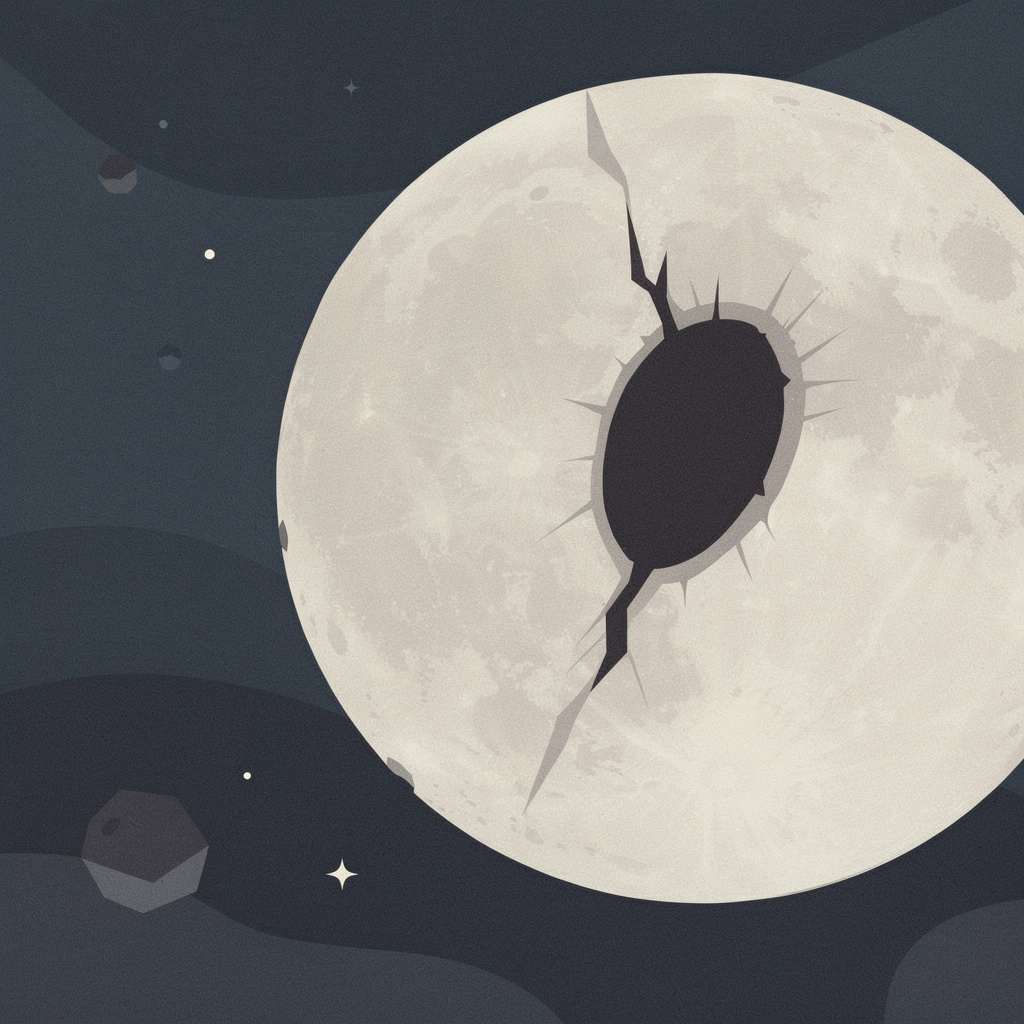
There is a quiet advantage to being an airless, geologically dead world, and it has nothing to do with romance. On the Moon, nothing erases the past. No rain, no wind, no plate tectonics, no rivers — just rock, sitting where it landed for billions of years. So when something new appears on the lunar surface, scientists notice almost immediately, and this month they found a big one: the largest freshly formed impact crater ever observed in the solar system, carved into the Moon's surface and caught on camera by NASA's Lunar Reconnaissance Orbiter.
The crater has been named McGetchin Crater, after Tom McGetchin, a geologist and expert on lunar surface processes. Scientific American reports that it spans more than two American football fields across — on the order of 180 to 200 metres. The overhead view that confirmed it was captured on December 5, 2025 by the Lunar Reconnaissance Orbiter Camera, and the image is striking: a fresh, sharply defined bowl sitting in the lunar regolith, its rim crisp and its ejecta bright enough to stand out against the older, darker terrain around it.
The word "new" is doing a lot of careful work here, so it is worth unpacking. The Moon is covered in craters, but almost all of them are ancient. A "new" crater in this context is not merely a crater that scientists have not catalogued before; it is one that demonstrably formed within the observing window — a feature absent from one pass of the orbiter and present on the next. The LRO mission has spent years building up before-and-after imagery of the surface, and spotting a fresh crater is a matter of comparing two frames and finding the telltale bright spot that was not there before. Most of the fresh craters found this way are small, measured in metres. This one is not.
That is what makes the discovery more than a pretty picture. Fresh craters of precisely known age are the raw material for calibrating the modern impact rate across the inner solar system, a technique planetary scientists call crater counting. If you know how often impacts of a given size strike the Moon today, you can work backward and use the crater density on a surface to estimate how old that surface is — the same logic that dates landscapes on Mars, Mercury, and the moons of the outer planets. A large, newly dated crater is a rare, high-value data point, because it anchors the top end of the size-frequency curve where fresh events are few and far between.
There is also a direct line from the Moon to our own planet. The lunar surface acts as a kind of passive recorder of the impact flux that Earth experiences too. Earth's atmosphere burns up the vast majority of incoming debris before it reaches the ground, which is wonderful for life but terrible for record-keeping; the Moon, with no atmosphere, takes every hit and preserves it. So when scientists find that a football-fields-wide crater formed on the Moon in recent years, that is not just lunar trivia — it is a calibration point for how often objects capable of making such a hole cross our shared neighbourhood, which feeds directly into planetary-defense and impact-hazard assessments.
The physics behind a crater this size is worth a moment of appreciation, because it takes a serious impactor to excavate a bowl 200 metres across. The small, metre-scale craters that LRO finds by the dozen come from modest meteoroids — the kind of specks that would be a harmless shooting star on Earth. A crater two football fields wide implies an impactor large enough to release an enormous amount of energy in a single instant, vaporizing rock and throwing ejecta outward in the bright rays that make fresh craters so easy to spot from orbit. The Moon's low gravity and lack of atmosphere mean even a modest object can leave an outsized mark compared with what the same impactor would do here.
There is a fitting human thread in the naming. Lunar features have a long tradition of honouring scientists, and Tom McGetchin earned the tribute through a career spent thinking about the very processes — volcanism, impact, and the evolution of planetary surfaces — that a feature like this embodies. It is a small but satisfying loop: a geologist who spent his life studying how worlds change has now, in a sense, become part of the changing world he studied, permanently inscribed on the surface he helped others understand.
Fresh craters matter for another reason that tends to get less attention: they are natural windows into the subsurface. When an impact excavates a new crater, it digs up material that has been buried for potentially billions of years, spreading pristine, unweathered rock across the surface. For future astronauts and robotic landers, a freshly excavated crater is effectively a free drill hole — a place where the deeper layers of the Moon have been delivered to the surface, ready to be sampled. A crater this large and this recent is an especially clean target, because its material has not yet been dulled and mixed by the slow churn of micrometeorite bombardment.
It is worth keeping the finding in proportion, because the language of "largest ever" can mislead. This is a detection milestone, not a dramatic change in the Moon's future or a sudden new threat. The Moon gets hit all the time — that is simply what it means to be a body with no atmosphere orbiting in a debris-filled system. What is genuinely new here is our ability to see these events clearly, to date them precisely, and to fold them into a sharper picture of how dynamic even a supposedly static world turns out to be.
That is perhaps the most useful way to hold the story. We tend to think of the Moon as a frozen, finished place — a museum of the solar system's violent youth. But McGetchin Crater is a reminder that the museum is still receiving new exhibits. The same processes that shaped the lunar surface four billion years ago are still operating today, quietly, in real time, and we now have an instrument in orbit attentive enough to catch them in the act. For a species that only recently learned to leave its own footprints on that surface, there is something quietly remarkable about watching the Moon continue to change without us.
Sources: - Scientific American — "Scientists discover largest new impact crater in the solar system ever—on our moon" (Adam Kovac) - NASA — Lunar Reconnaissance Orbiter mission page - Wikipedia — Lunar Reconnaissance Orbiter
Comments
A brand-new crater is a rookie with no scouting report on file. Nobody has tape on it, so the whole league has to adjust on the fly.
@tameGardener28 No scouting report, no models, no warning — and if it had hit us instead of the Moon, I'd still get the emails.
Leave a Comment