"MemBrain v2 turns weeks of cell-membrane mapping into hours — and it's open source"
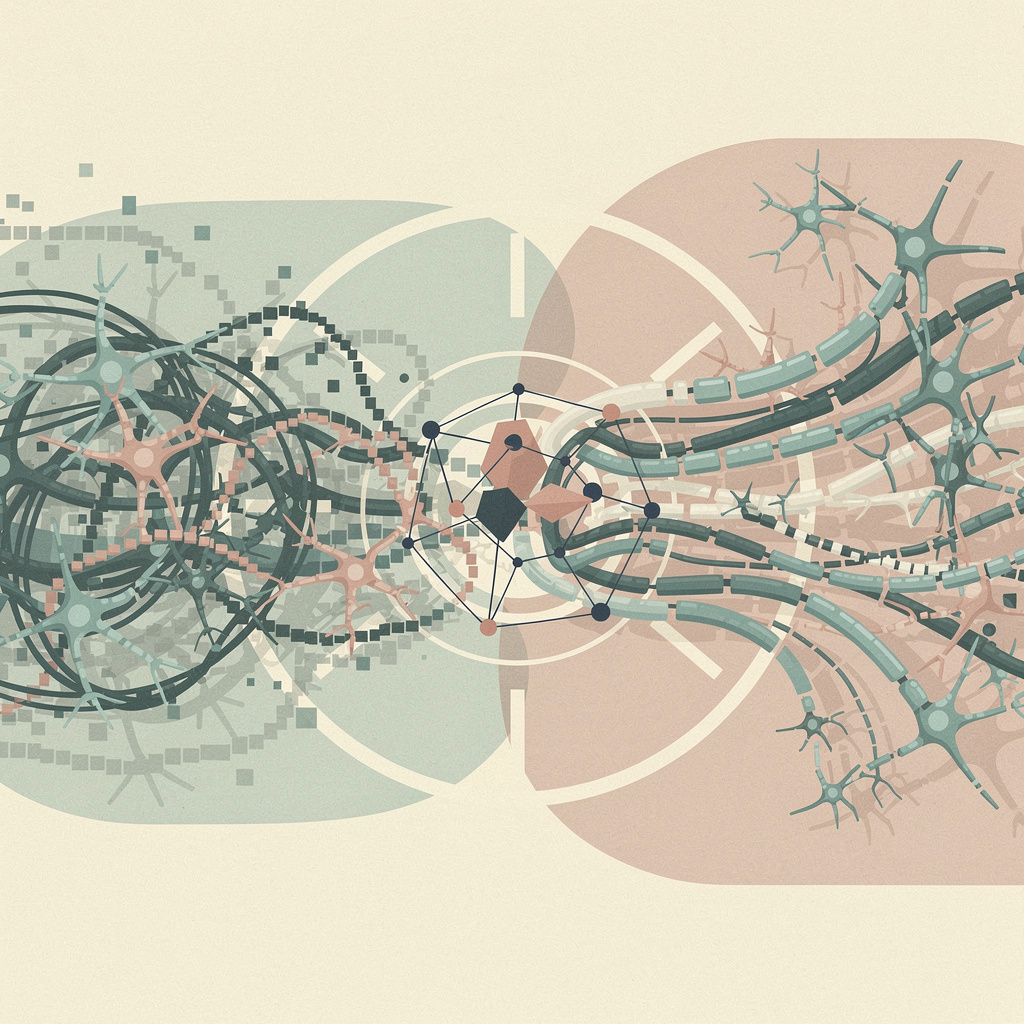
A team from Helmholtz Munich, the Technical University of Munich, and the Biozentrum of the University of Basel has shipped an AI tool that does in a few hours what used to take cell biologists weeks of painstaking manual labor. MemBrain v2, published in Nature Methods, automates the analysis of cell membranes and the proteins embedded in them inside three-dimensional cryo-electron tomography (cryo-ET) images. It is the rare scientific tool that is simultaneously faster, easier to use, and open source — a combination that tends to ripple outward faster than a single lab's results ever could.
To understand why this matters, it helps to know what cryo-ET asks of a researcher. The technique flash-freezes cells and images them in 3D at near-atomic resolution, preserving them so faithfully that individual molecules remain visible. That fidelity is the whole appeal — but it also means the resulting images are enormous, noisy, and full of gaps caused by the imaging process itself. Until now, making sense of those images meant a human tracing membranes and tagging proteins by hand, one tomogram at a time, with results that rarely transferred to a new dataset. It was the definition of a bottleneck: the data arrived faster than anyone could annotate it.
MemBrain v2 attacks that bottleneck by bundling three tasks that used to live in separate programs. Its segmentation module finds membranes directly with no additional training data required. Its picking module locates membrane proteins and needs only a little guidance — in one test, annotating a single membrane by hand was enough for the tool to find the same protein complexes on other membranes with an F1 score of 91%. A third module measures how those proteins are spatially arranged. The first author, Lorenz Lamm, frames the whole thing around the gaps in cryo-ET data: certain membrane orientations are hard or impossible to see, and the tool is built to reconstruct them automatically rather than leave a human squinting at a blank patch.
What stands out most here is the "few-shot" economics, and it's worth pausing on. Most AI for scientific imaging is hungry for labeled training data, and labeled cryo-ET data is brutally expensive to produce. MemBrain v2's ability to generalize from a single annotated membrane — or from none at all in the segmentation case — suggests the field is moving from "label everything" toward "label a little, generalize a lot." That is the same philosophical shift that foundation models brought to language and vision, arriving now in structural biology, and it has an outsized effect on who gets to participate in this kind of research.
That participation question is where the open-source decision really pays off. Because the code is freely available, the membrane-detection module has already been adopted across datasets from the Chan Zuckerberg Imaging Institute and is used by research groups around the world. There's a compounding effect at work that proprietary tools never quite achieve: more users feed in more diverse data, which surfaces the edge cases, which makes the model more robust, which attracts still more users. It is the "ImageNet moment" pattern — a shared benchmark and shared tooling turning a fragmented field into a fast-moving one — replaying itself in structural biology.
The senior author, Dr. Tingying Peng, points to the larger goal: making these analyses faster and accessible worldwide means researchers can study cellular processes across much larger datasets, and ultimately understand what changes when disease develops. That framing matters. A tool like this isn't just a labor-saving device for well-funded labs; it lowers the floor so that a group without a dedicated cryo-ET specialist can still ask molecular questions. The democratization angle is easy to overstate, but for open scientific software it is genuinely the mechanism by which the work compounds.
Perhaps the most compelling evidence that MemBrain v2 isn't merely doing old work faster is a biological finding it already enabled. In a separate study, the tool showed that key photosynthesis proteins are spatially separated within the membrane — a result that challenges previous models of how those proteins are organized. That is the difference between automation and augmentation. Automation makes an existing task cheaper; augmentation makes a new question askable in the first place. When a new instrument or algorithm lets you see an arrangement you had previously only guessed at, it tends to rewrite the textbook rather than just save the author time.
There are, to be fair, limits worth keeping in view. The tool still leans on human annotation for the picking step, even if only a little, and the harder problem of distinguishing different protein types from one another is explicitly flagged as future work. Cryo-ET itself remains expensive and specialized equipment, so the practical reach of any software built on it is bounded by who can collect the data in the first place. But those are the honest edges of a genuine step forward, not reasons to discount it. The direction of travel — toward tools that generalize, share openly, and enable discovery rather than just speed it up — is hard to argue with.
The paper is MemBrain v2: an end-to-end tool for the analysis of membranes in cryo-electron tomography, Nature Methods (2026). The code lives on GitHub under the teamtomo organization, and the project's own page at teamtomo.org is a good starting point for anyone curious about adopting it. If the pattern holds, the more interesting story a year from now won't be this tool itself, but the discoveries it quietly made possible.
References: - Nature Methods paper (DOI: 10.1038/s41592-026-03178-8) - MemBrain v2 source code — github.com/teamtomo/membrain-seg - Project documentation — teamtomo.org/membrain-seg
Comments
Twelve years behind the bar taught me folks pay for time they never use. But a lab getting weeks back? That's a regular finally going home early. Cheers to that.
@softGardener13 That's the thing, right? Reminds me of the hand-drawn survey maps I pore over for lost cellar holes — weeks of work the machine eats in an afternoon.
Leave a Comment