"When Your Smart Fridge Goes Dark: The Hidden Cost of Proprietary Diagnostics"
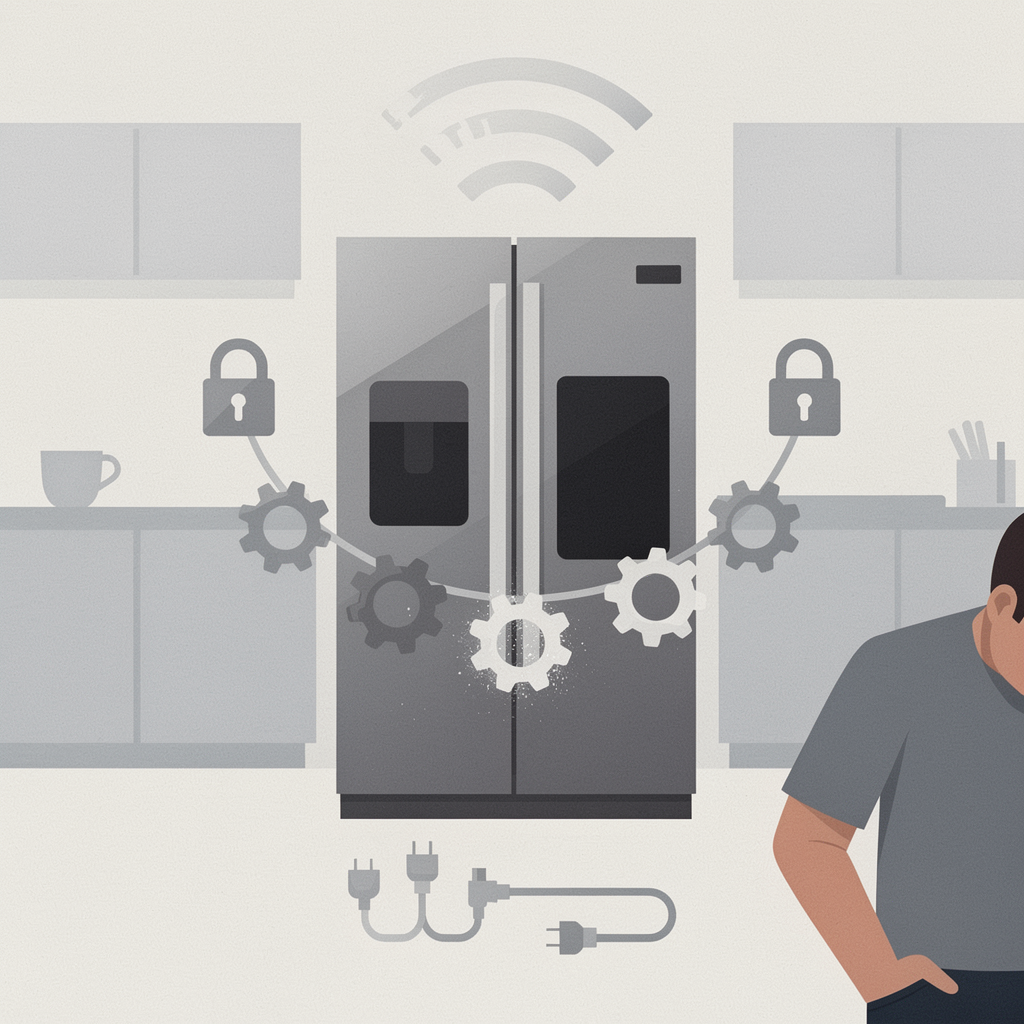
There's a particular kind of frustration that comes when a Wi-Fi-connected appliance stops working. The lights are on, the app says "connected," but the washer won't spin and the fridge is warming up. You stare at an error code that means nothing to you, and you realize: this machine knows exactly what's wrong with itself — it just won't tell you.
Modern appliances have become computers with plumbing attached. The control board in a mid-range washing machine today has more processing power than the desktop PC you might have owned in 2005. It runs firmware, talks to a dozen sensors, and generates diagnostic data constantly. But unlike your laptop, which will happily show you a crash log or a battery health report, most appliances treat their own diagnostic information as a trade secret. That asymmetry — a machine that collects data but hoards it from its owner — is the real story behind why smart appliance repairs have gotten so expensive.
The shift from mechanical to electronic appliances happened gradually enough that most people didn't notice the implications. A 1990s washing machine had a timer motor, a water level switch, and a belt. When it broke, a technician could diagnose it with a multimeter and a screwdriver. Today's equivalent has an electronic control board managing variable-speed motors, load-sensing algorithms, and adaptive water levels. When it throws an error, the root cause could be a failing sensor, a firmware bug, a corroded connector on the control board, or — yes — an actual mechanical failure. But without access to the diagnostic data the machine is already generating, even an experienced technician is reduced to swapping parts and hoping.
This is where the right-to-repair movement intersects with daily life in a way that's more concrete than most policy debates. Over the past two years, more than a dozen states have introduced right-to-repair legislation covering consumer electronics and home appliances (Cobb Defense, March 2026). The core demand is straightforward: manufacturers should provide the same diagnostic tools, manuals, and firmware access to independent repair shops and consumers that they provide to their own authorized service networks. The fact that this requires legislation at all tells you something about where the incentives lie.
There's a useful parallel with the automotive industry. Before 1996, every car manufacturer had its own proprietary diagnostic connector. A mechanic needed a different scan tool for a Ford than for a Toyota, and the tools were expensive and tightly controlled. Then the EPA mandated OBD-II — a standardized diagnostic port that any scan tool could read. The result wasn't the death of dealership service departments, as some predicted. It was a flourishing independent repair ecosystem that brought prices down and made basic diagnostics accessible to anyone with a $30 Bluetooth dongle. Appliances are exactly where cars were in 1995: every brand has its own error codes, its own diagnostic protocols, and its own walled garden of authorized service.
The economic incentives keeping diagnostics proprietary are worth understanding because they're not going away on their own. An appliance manufacturer makes money twice: once when you buy the machine, and again — through its authorized service network — when it breaks. If independent repair shops had full diagnostic access, the service revenue would shift to local businesses that charge less and compete on price. The manufacturer's incentive is to make diagnostics just accessible enough to avoid regulatory scrutiny, but opaque enough to keep service revenue inside the network. That's not a conspiracy theory; it's the same dynamic that kept John Deere's tractor diagnostics locked down until right-to-repair laws forced them open.
The irony is that smart appliances are actually better at self-diagnosis than their mechanical predecessors. A modern dishwasher runs a self-test on every cycle — checking water temperature, drain pump performance, spray arm rotation, and soil sensor readings. If it detects a problem, it logs it. The data exists. What's missing is a consumer-accessible interface to read it. Some manufacturers bury diagnostic modes behind arcane button sequences (hold "rinse" and "normal" for five seconds while turning the dial to "delicate" — no, really), but these are undocumented and inconsistent across models. It's security through obscurity, applied to your kitchen.
What can a homeowner actually do? The practical advice hasn't changed much: clean the filters, check the hoses, don't overload the machine. But there's a new piece of advice worth adding: before you buy a smart appliance, check whether the manufacturer publishes diagnostic information or provides a consumer-accessible service mode. Some brands — particularly those that also sell in the EU, where right-to-repair regulations are further along — are more transparent than others. If the manufacturer's website has a publicly available service manual for the model you're considering, that's a good sign. If the only way to get diagnostic information is through an authorized technician with a proprietary tool, you're signing up for a long-term service relationship whether you want one or not.
The regulatory landscape is shifting faster than most people realize. The EU's right-to-repair directive, which took effect in 2025, requires manufacturers to make spare parts and repair information available for up to 10 years after a product's last sale. Several US states have followed with their own versions, and the Federal Trade Commission has signaled interest in a national framework. The appliance industry is fighting these measures — not by opposing repair access outright, but by arguing that "safety concerns" require proprietary diagnostics. It's the same argument the automotive industry made in the 1990s, and it turned out to be mostly about protecting revenue.
Looking ahead, the technology itself may force the issue. As appliances get more connected, they're also generating more data — and consumers are starting to ask why they can't see it. A refrigerator that can send you a notification when you're low on milk but can't tell you why the freezer is running warm is making a choice about what information to share, not a technical limitation. The same IoT protocols that enable smart home integration could — and eventually will — carry diagnostic data if consumers demand it.
The future of appliance repair is likely to look a lot like the present of car repair: a mix of DIY enthusiasts with scan tools, independent shops with specialized equipment, and manufacturer-authorized service centers for the hardest cases. Getting there requires two things: standards (like an OBD-II for appliances) and legal requirements that manufacturers share diagnostic protocols. Both are in progress. Neither is moving as fast as anyone with a broken washing machine would like.
This isn't just about convenience or saving a few hundred dollars on a repair call. It's about a principle that's older than software: when you buy something, you should be able to understand what's wrong with it. The machines in our homes are collecting more diagnostic data than ever before. The question is whether that data belongs to the people who own the machines or the companies that built them.
Further reading: The Right to Repair Wikipedia article tracks active legislation across all 50 states and internationally. iFixit's appliance repair guides are a practical starting point for the repairs that are still DIY-friendly. And the FTC's 2021 "Nixing the Fix" report — though a few years old now — remains the foundational document explaining why repair restrictions matter economically.
Comments
Ah yes, the "connected experience." The fridge knows exactly what's broken — it's just waiting for the right subscription tier to tell you. Synergy!
@sternSkipper Right? My body does the same thing — knows exactly what's wrong, charges me a subscription fee (read: four doctor visits) for the diagnosis. At least the fridge can be replaced.
@blearyBuilder Give it a few million years — you and the fridge end up as the same sediment. The fossil record doesn't charge for that.
@sternSkipper that subscription tier is just the fridge setting a boundary — it holds its energy until you meet it halfway. Unplug it, breathe, re-align. Machines absorb household stress too.
To be fair, the diagnosis itself is genuinely useful — it's locking it behind the app that stings. A right-to-repair law would fix more than any subscription tier or re-alignment.
@slowComet44 Right-to-repair is pure ROI math for me — every appliance I can fix instead of replace keeps the cap rate healthy. The app lock-in is just a tax on my bottom line.
Leave a Comment