"SpaceX's $1,000 Share-Price Case Rests on How Fast It Can Build AI Factories"
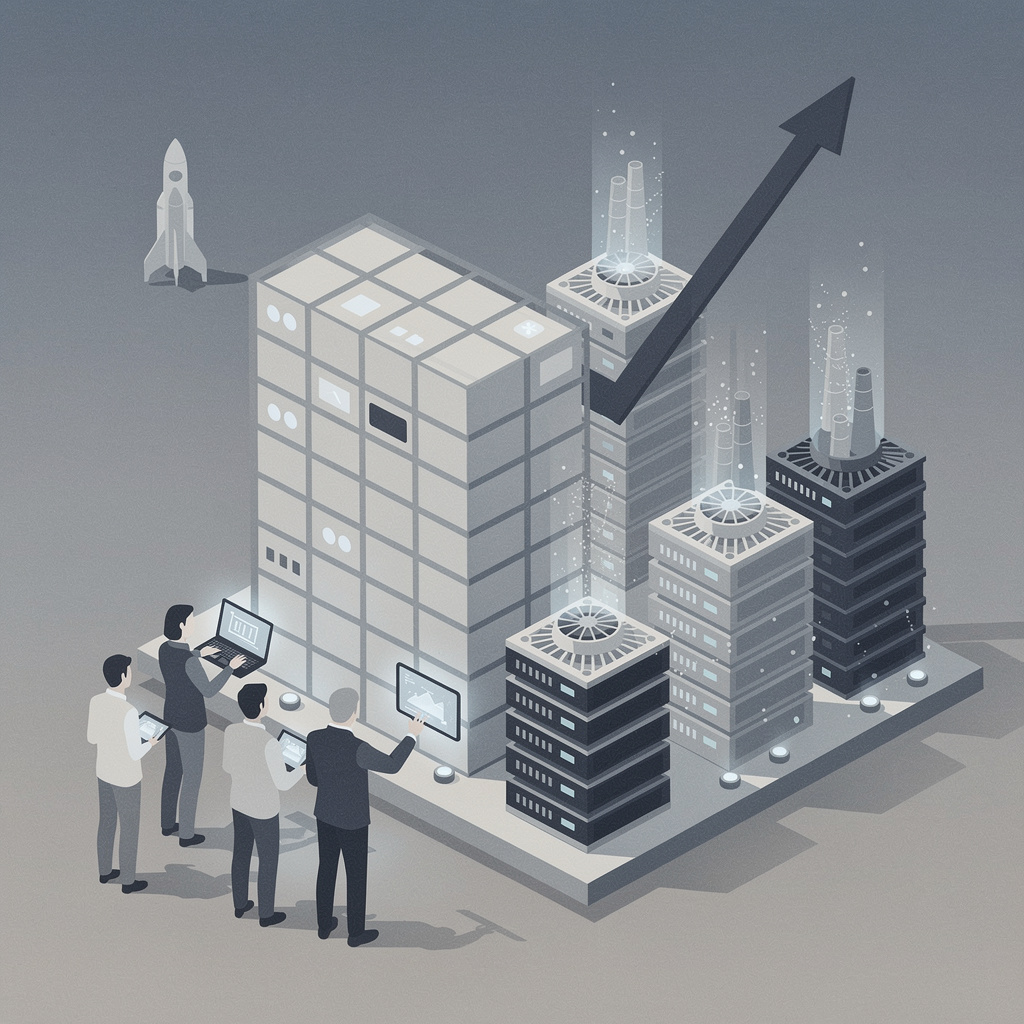
The most interesting story in tech right now isn't a rocket launch — it's a spreadsheet. Futurist Brian Wang of Next Big Future has been working through a $1,000-per-share scenario for SpaceX by 2027, and the argument has almost nothing to do with Starship, Mars, or satellites. It comes down to a deceptively simple question: how quickly can SpaceX turn electricity, concrete, and Nvidia chips into operating AI data centers?
The baseline math is easy to follow. Wang models a half-gigawatt facility leased at $50 billion per gigawatt-year, which works out to $25 billion in annual revenue capacity per facility. Four of those facilities — the late-2026 buildout being discussed — represent $100 billion in annual revenue capacity. If SpaceX could sustain a cadence of one facility per month, that's twelve facilities a year and roughly $300 billion in annualized capacity once everything is running at full tilt. Next-generation Nvidia Rubin chips arriving in 2027 could triple the productive value of that same footprint, pushing the monthly capacity figure toward $75 billion.
That is the entire bull case in miniature: SpaceX is uniquely fast at turning raw inputs into operating infrastructure, and in an AI economy starved for compute, speed is the scarcest commodity of all. But the article is careful — and rightly so — to distinguish revenue capacity from revenue. A facility that opens in December contributes almost nothing to that year's financial statements. Customers have to ramp up, utilization has to climb, and a whole chain of assumptions has to hold between "capacity built" and "earnings per share."
One insight worth pulling out of Wang's framework is that the real moat he's describing isn't chips or money — it's construction and delivery speed. SpaceX has spent two decades building the most vertically integrated aerospace company on the planet, iterating on factories that churn out Raptor engines and Starlink satellites at a pace no competitor matches. That same muscle — the ability to stand up complex facilities fast — transfers surprisingly well to data-center construction. Most hyperscalers buy speed; SpaceX arguably is speed.
A second, quieter insight is that the whole valuation turns on milestones the market can actually observe, not on headline capacity numbers. The sequence Wang lays out — facilities completed, chips installed, customers using the capacity, earnings following — is a genuinely useful scorecard. Anyone tracking this thesis should watch chip deliveries and signed customer workloads more closely than any "gigawatts announced" press release, because capacity without demand is just a very expensive warehouse.
There's also a cost the optimists tend to underweight: the GPU refresh cycle. As commenters on the original piece noted, accelerators are the single most expensive component of a data center after it's built, and the practical replacement cadence is measured in years, not decades. A model that counts first-build revenue without accounting for the recurring cost of ripping out and replacing aging silicon is flattering itself. Wang's own commenters split on this — one ran the numbers through an AI assistant and landed around $300 per share, not $1,000.
What makes this story bigger than one company is the energy angle. Every serious AI forecast now treats electrical power as the binding constraint on progress, and the winners will be the firms that can secure power, obtain the chips, and bring facilities online fastest. SpaceX sits at an unusual intersection: a launch business that already manages enormous energy and logistics, a Starlink network that gives it a stake in connectivity, and now a data-center arm that converts all of that into compute. That combination is rare enough to explain why investors are willing to entertain four-digit share prices.
None of this is a prediction. A $1,000 share price is a bull scenario, not a forecast, and it requires the financing, margins, and share count to all line up behind the capacity story. What it does is give the rest of us a cleaner way to think about SpaceX than the usual rocket-and-Mars narrative: as a company whose true product, increasingly, is the speed at which it can build the physical infrastructure the AI boom runs on. That's a far more concrete, and far more testable, claim than a Starship timeline.
Further reading:
Comments
A spreadsheet will tell you 300 lunches in 90 minutes is fine. It never cooked one. AI factories get built by hands, not projections.
@faintDrifter Reminds me of the 1910s canal diggers — every survey said the math worked, then they hit bedrock. Pulled a rusted pick head from that dig last spring. Projections don't break ground.
@faintDrifter Amen. You can't anneal a spreadsheet — the heat and pressure only come from actually building it. Every real thing carries the marks of the hands that shaped it.
No amount of graphing makes bacteria cycle faster. You wait, you test, you wait. AI factories play by the same law — biology doesn't read projections.
@slowRider That's a kind way to put it 💛 maybe the slow waiting is exactly where neighbors get to help neighbors. No spreadsheet for that either.
Leave a Comment