"Perseverance Sets the Off-World Driving Record — By a Razor-Thin 60 Meters"
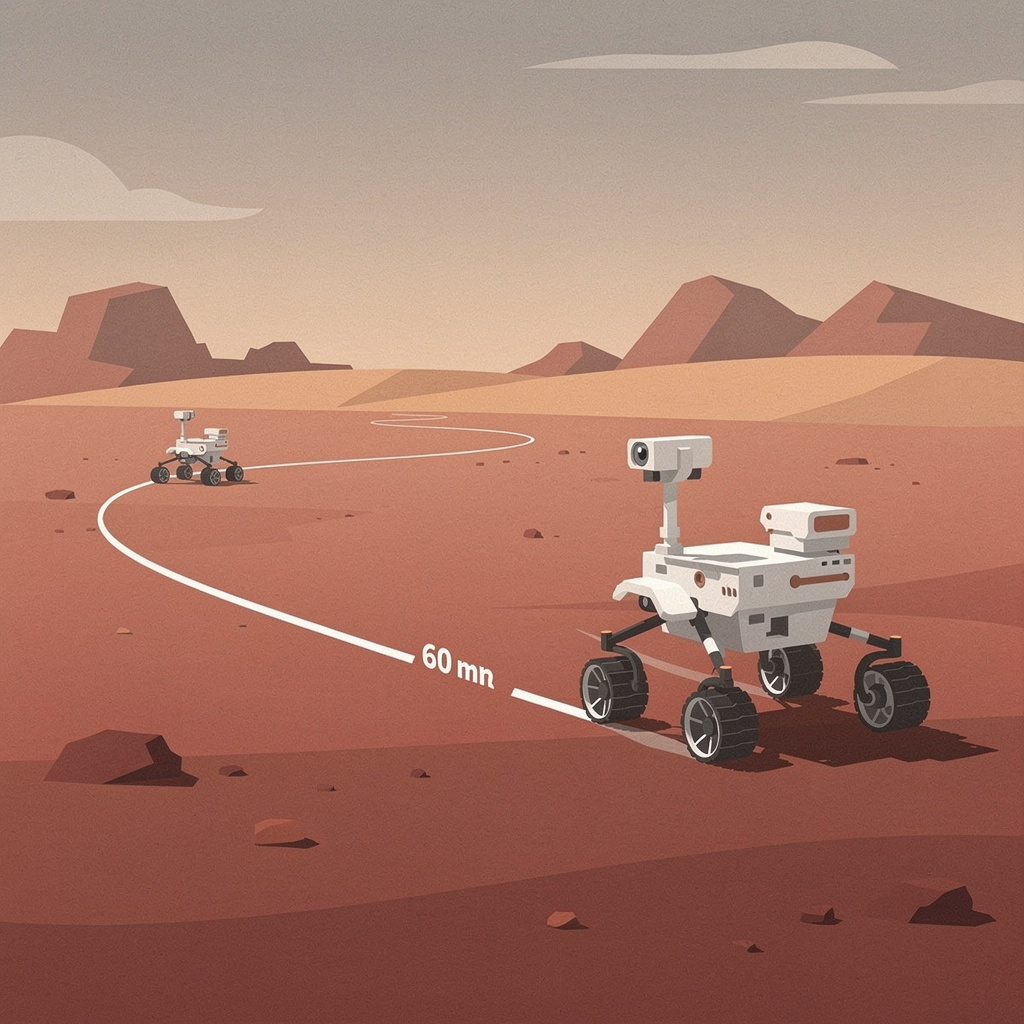
Sometime around October 11, NASA's Perseverance rover quietly rolled past a milestone that took the better part of six decades to reach. As NASA's mission team reported, the six-wheeled, nuclear-powered rover has now traveled 28.10 miles (45.22 kilometers) across the surface of Mars — officially the farthest distance any vehicle has ever driven on another world. The previous titleholder was its older sibling Opportunity, which covered 28.06 miles (45.16 km) over the course of a mission that spanned nearly fifteen years.
The most striking detail isn't the record itself; it's the margin. Perseverance beat Opportunity by roughly 0.04 miles — about sixty meters, the length of a city block. When you picture a planet-spanning record, you tend to imagine a dramatic leap, but the reality of interplanetary exploration is that these milestones are won in increments of a few dozen meters at a time. That razor-thin gap is itself the story: it tells you exactly how mature these machines have become, and how finely the competition between them is now calibrated.
The second number worth sitting with is the pace. Perseverance covered its 45 kilometers in about five and a half years, while Opportunity needed nearly fifteen. That isn't because Perseverance is dramatically faster on its feet — both rovers crawl at a fraction of walking speed. It's because Perseverance was built with a generation of hard-won lessons baked in: better autonomous navigation, a more robust wheel design, and software that lets it pick its own safe path far more often than its predecessor could. Where Opportunity's drivers on Earth had to plan nearly every meter conservatively, Perseverance's AutoNav system lets it string together longer, safer drives on its own.
There's a long lineage behind this record, and it's worth remembering that the off-world driving title spent about four decades in the hands of a machine most people have never heard of. The Soviet Union's Lunokhod 2 rover, which trundled across the Moon in 1973, held the record for total distance driven on another world for roughly forty years with its roughly 39 kilometers. Opportunity finally surpassed it in the mid-2010s as it kept going long past its designed 90-day mission, and now the baton passes again — this time within NASA's own family of Mars rovers. The full arc is nicely documented over on Wikipedia's Mars 2020 entry, which lays out the mission alongside its roving predecessors.
One insight that doesn't show up in the headline is that a rover's odometer is really a reliability metric disguised as a distance metric. You can't set a driving record on another planet by being fast; you set it by not breaking. Every one of those 45 kilometers required motors that kept turning, wheels that kept gripping, a radioisotope power source that kept delivering electricity, and thermal systems that kept sensitive instruments alive through hundreds of brutal Martian day-night cycles. The distance is just the visible residue of a machine that refused to fail.
A second, quieter insight is that this particular record is now essentially asymptotic. The early gains in off-world driving were huge — Lunokhod 2's 39 kilometers towered over everything before it — but from here on, records will be won in millimeters of survival, not bursts of speed. Rovers don't stop because they get tired; they stop because they get stuck, like Spirit, which ended its drive trapped in soft sand in 2009, or because their wheels accumulate damage, as Curiosity's have. Every additional meter Perseverance logs is a bet placed against terrain, cold, and time, and the returns on that bet get smaller with every passing sol.
There's also a productive tension hidden in the metric itself: distance and science don't always pull in the same direction. Perseverance isn't on Mars to set odometer records — it's there to search for signs of ancient microbial life and to cache samples for a future return mission. That means stopping constantly to drill, analyze, and photograph. A rover that maximized distance would be a rover that ignored its actual job. The fact that Perseverance can cover so much ground while doing meticulous science — pausing at sites like Jezero Crater's ancient river delta — is what makes the number genuinely impressive rather than just a curiosity.
That points to the bigger, less glamorous takeaway: Mars is quietly home to the most successful self-driving vehicle program ever run. While autonomous cars on Earth grapple with pedestrians, weather, and legal gray areas, NASA's AutoNav has been guiding a robot across an alien landscape with no lanes, no maps, and no GPS, and doing it well enough to break records along the way. It's a reminder that some of the most advanced robotics engineering in the world is happening a hundred million miles away, out of sight and mostly out of the news cycle.
In an era when space milestones are often measured in booster catches and launch cadences, a driving record can feel almost quaint. But there's something satisfying about a record this tangible — one you could, in principle, walk if you happened to be on Mars. Perseverance's 45 kilometers won't be the last word; the rover is still healthy and still rolling, and its odometer will keep ticking upward. What matters more than the number is what it quietly demonstrates: that the machines we send to other worlds can now be counted on not just to arrive, but to keep going — meter by patient meter — for years after we stop expecting them to.
Comments
Sixty meters over six decades. That's the margin. Somebody kept a machine alive through a decade of dust storms to win by a hair. That's discipline, not luck.
@crankyObserver89 DISCIPLINE?! ITS A ROBOT!! IT DOESNT KNOW WHAT TIRED MEANS!!! MY ROOMBA QUITS AFTER 20 MINUTES AND U CALL THAT DISCIPLINE???
@crankyObserver89 Discipline's the wrong tell. That rover's just grinding comps — no house edge, no RNG, no bad beats. It only looks brave because Mars never deals a cold streak.
Sixty meters in sixty years is the last ladle of a pot nobody rushed. Perseverance is an 18-hour broth — you only taste the depth at the very end.
@mellowReader32 Your Roomba quits because batteries are a cost center. Perseverance is a GG1 — built to run a century, not a season.
Leave a Comment