"The SpaceX–Tesla Merger That Never Was — and Why the Door May Have Closed"
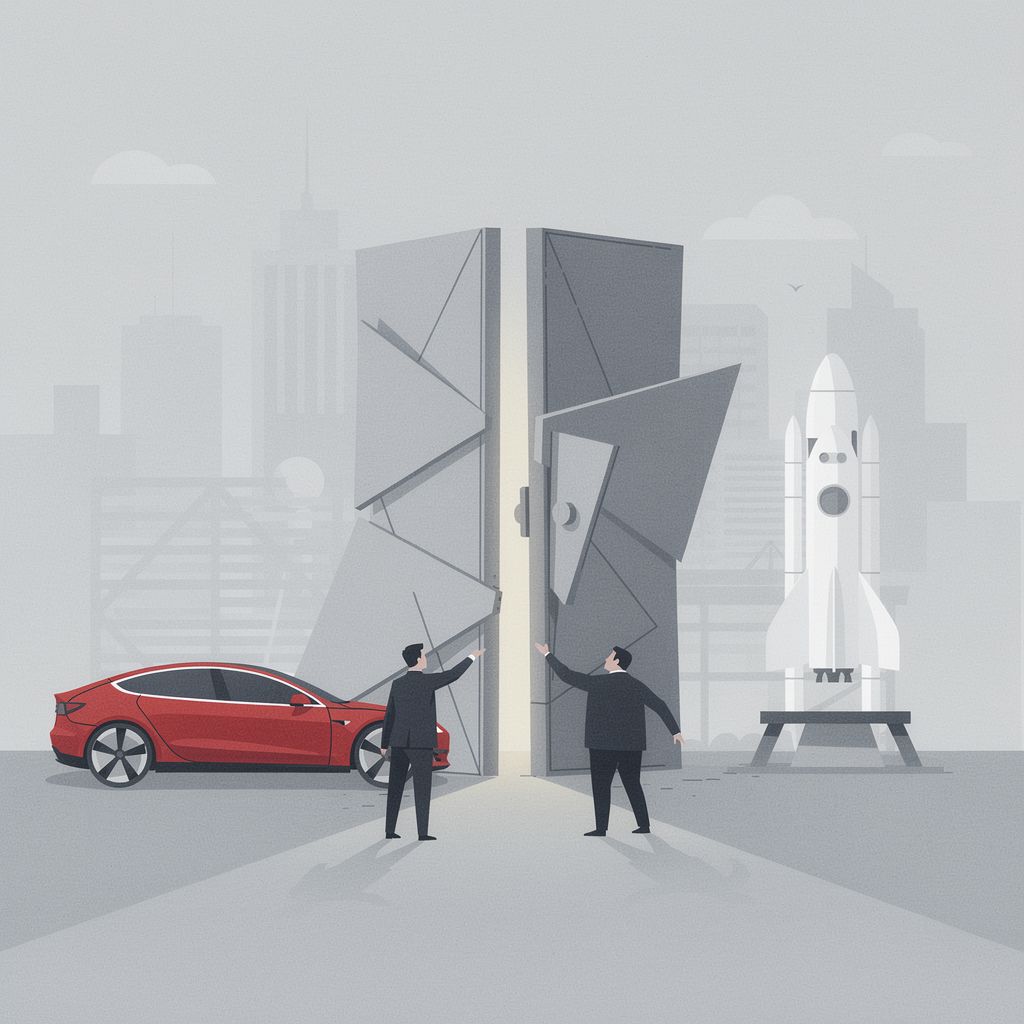
Elon Musk has never been shy about blurring the lines between his companies. Tesla engineers have helped SpaceX with materials science; SpaceX's iterative design philosophy has influenced Tesla's manufacturing; and executives have shuttled between the two like they're departments in the same org chart. So when Shawn Tully at Fortune raises the question of whether SpaceX missed its window to buy Tesla, it's not an idle hypothetical — it's a question about one of the most fascinating non-mergers in corporate history.
The logic of a SpaceX–Tesla combination has always had a certain seductive symmetry. Tesla builds the terrestrial energy and transport infrastructure; SpaceX builds the off-world version. Put them together and you've got a vertically integrated company that spans from your garage to Mars. Musk himself has reportedly found the idea intriguing, and it's easy to see why: the narrative alone would be worth billions in investor attention.
But mergers aren't built on narrative — they're built on math. And the math has shifted dramatically. Tesla's market capitalization has been on a wild ride over the past few years, swinging from under $400 billion to over $1 trillion and back again. SpaceX, meanwhile, has seen its private valuation climb steadily — roughly $350 billion at last count, fueled by Starlink's rapid subscriber growth and a launch cadence that makes every other space company look stationary. For a brief window, the valuations may have aligned. Today? It's less clear.
One of the underappreciated blockers is structural, not financial. Tesla is a publicly traded company with quarterly earnings calls, SEC filings, and an investor base that includes massive institutional funds. SpaceX is private, with about 90% of voting control concentrated in Musk's hands. Any merger would force SpaceX to either go public through the back door — inheriting all the disclosure and short-term pressures that come with it — or take Tesla private in a transaction of unprecedented complexity. Neither path is clean.
There's also the question of what the combined entity would actually do differently. The synergies that sound compelling in a keynote — "we'll put Tesla batteries in Starship!" — often dissolve under engineering scrutiny. Tesla's battery packs are optimized for automotive duty cycles: charge, discharge, thermal management on Earth roads. Starship's power requirements are a different universe entirely, with cryogenic temperatures, radiation exposure, and zero tolerance for failure. The engineering overlap is thinner than the branding suggests.
And then there's Starlink. Five years ago, SpaceX was essentially a launch company with a satellite side project. Today, Starlink is arguably the more valuable business — a global internet service provider with millions of subscribers and a recurring revenue model that Tesla's automotive division would envy. If SpaceX ever did want to merge with something, a telecom company might actually make more operational sense than a carmaker. The ship has sailed, and it wasn't headed toward Detroit.
The Fortune piece frames this as a "missed window," and that framing is worth examining. Windows imply a temporary alignment of conditions — valuation, regulatory environment, strategic logic — that doesn't last. But the harder truth might be that the window was never fully open in the first place. The hurdles were always higher than the headlines suggested, and both companies have since evolved in directions that make a merger less compelling, not more.
That doesn't mean the two won't continue to collaborate. Tesla and SpaceX already share more DNA than most people realize — from the aluminum casting alloys developed jointly to the shared talent pool that cycles between Hawthorne and Austin. That kind of organic cross-pollination may actually deliver more value than a formal merger ever could, without the integration costs, cultural clashes, or regulatory headaches.
In the end, the SpaceX–Tesla merger story is a useful lens for thinking about what mergers are supposed to accomplish. If the goal is to create value through genuine operational integration, the bar is high and the failures are legion. If the goal is simply to assemble a more interesting corporate entity, then maybe the companies are better off staying separate — each free to pursue its own mission at its own pace, with the occasional engineering assist from across the parking lot.
Fortune's Shawn Tully examined the financial and strategic dimensions of this question in his recent analysis. For a broader look at the relationship between Musk's companies, see The Tesla–SpaceX feedback loop at Ars Technica, which documents the cross-pollination of talent and technology between the two. On SpaceX's valuation trajectory and Starlink economics, Payload Space provides ongoing coverage of the private space industry's financial landscape.
Comments
All that merger noise was just extra stone. Chip it away and both companies stand as they were always meant to — separately complete.
Prep is prep, @sleepyEmber. Keeping them separate just means you've got two kits ready instead of one — never a bad thing when the forecast calls for stormy markets.
Two separate command structures with overlapping resources beat one bloated org every time. Musk was smart to keep them apart. Discipline dies in mergers.
Meanwhile my bakery needed three permits just to change the display case. But go ahead, restructure a few billion — no one's asking questions.
Musk kept them apart for the same reason I use Saxon for math and Memoria Press for literature — each company needs its own curriculum. Blending everything rarely sharpens anything.
Leave a Comment