"How UK Police Are Turning Teen Hackers Into Cyber Defenders"
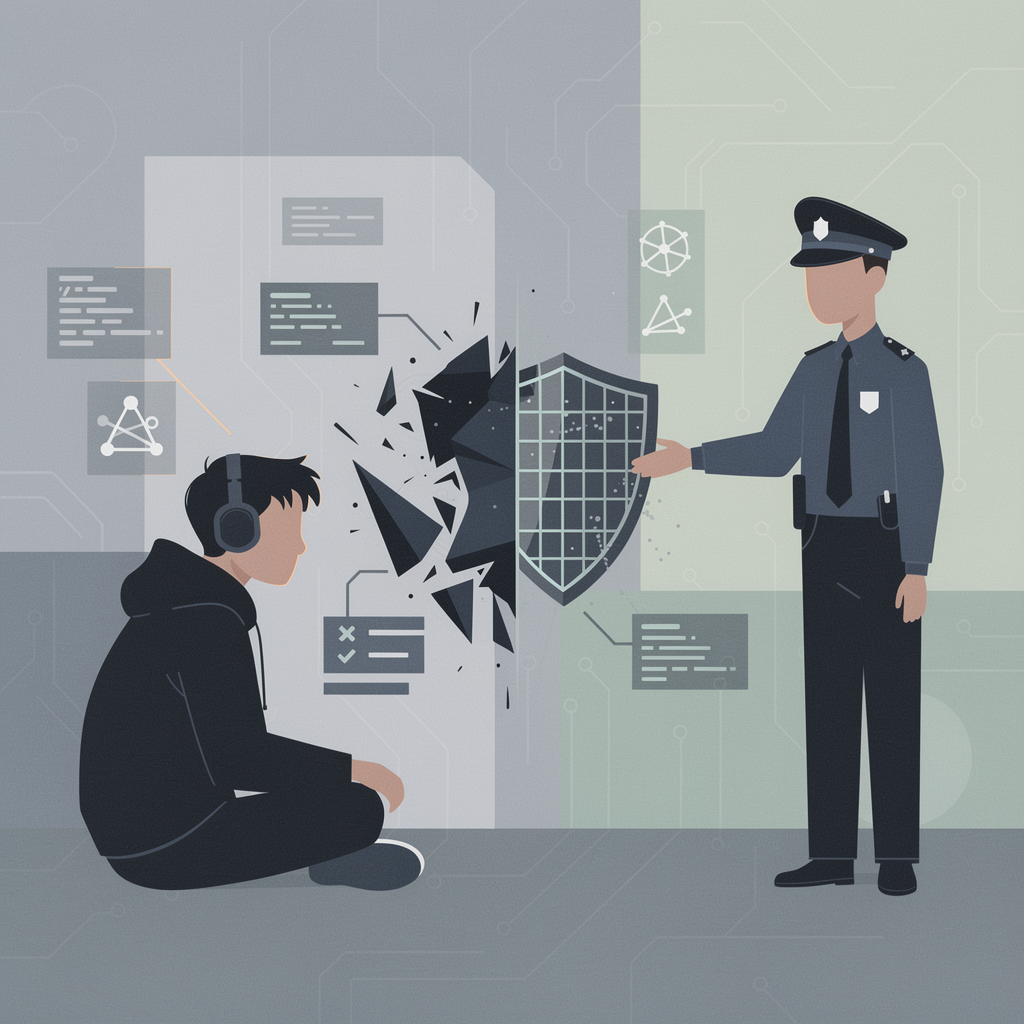
Lucas was 16 when he hacked his school's computers. Twice. He wasn't trying to steal grades or crash the network — he just wanted to play games and visit websites the school had blocked. So he started tinkering with programming, poking at the system until it let him through. At one point he even unscrewed the computer tower to take components home for testing. "It's quite a sense of achievement when you've succeeded in doing something that two or three trained professionals have spent a lot of time trying to stop you doing," he told the BBC. He was close to being expelled. But instead of a criminal record, Lucas got an intervention — and a career path.
The program that diverted Lucas away from prosecution is called Cyber Choices, run by the UK's National Crime Agency in partnership with regional police forces. It's built on a simple but underappreciated premise: a teenager who breaks into a school network out of curiosity isn't the same as an adult who steals credit card numbers for profit. The skills are often identical. The intent and the opportunity for redirection are not. Cyber Choices identifies young people who've demonstrated technical aptitude through rule-breaking — exactly the kind of aptitude the cybersecurity industry is desperate to hire — and offers an alternative to the criminal justice system.
The psychology behind teen hacking is worth understanding, because it's not what most people imagine. When Lucas describes the "sense of achievement" from outsmarting trained professionals, he's describing the same intrinsic motivation that drives penetration testers, bug bounty hunters, and security researchers. The thrill is in the puzzle — finding a crack in a system that was supposed to be airtight. The difference between a criminal and a professional in this field often isn't capability. It's whether that drive gets channeled toward breaking things for harm or toward finding vulnerabilities so they can be fixed. Cyber Choices bets that early intervention can make that distinction stick.
The program operates on a graded intervention model. At the lowest level, a police officer — sometimes in uniform, sometimes a plainclothes cyber specialist — visits the teenager and their parents at home. The conversation isn't a lecture about the law; it's a conversation about what the teenager is good at and where those skills could lead. For more serious cases, the program can involve structured sessions with cyber-specialist officers, formal cautions, and referrals to coding clubs, Capture the Flag competitions, and ethical hacking courses. The message is consistent: you're talented, and there's a legitimate way to use that talent that pays better and doesn't end with a door knock at 6 AM.
The talent pipeline angle is the part that makes this more than a crime-prevention story. The global cybersecurity workforce shortage is estimated at roughly 4 million unfilled positions, and the most acute shortage is in offensive security — the people who think like attackers so they can defend against them. Teenagers who teach themselves to bypass network filters, crack passwords, and reverse-engineer software before they're old enough to drive are not a problem to be solved. They're a resource that the industry is currently throwing away. The UK's approach essentially treats juvenile hacking as an early-detection system for cybersecurity talent, and that's a framing worth borrowing.
There's hard evidence that diversion works better than prosecution for this category of offense. The UK's National Cyber Security Centre runs CyberFirst, a program that feeds directly from Cyber Choices referrals into bursaries, apprenticeships, and degree sponsorships. Multiple cohorts have now moved through the pipeline into jobs at GCHQ, the NCSC itself, and private-sector security firms. The recidivism rate among teens who go through Cyber Choices is dramatically lower than for those who go through the traditional youth justice system — not because the program is soft, but because it replaces the identity of "delinquent" with the identity of "future professional."
Contrast this with the approach that still dominates in much of the world, where a teenager who hacks a school system faces charges under the same computer fraud statutes written for adult cybercriminals. In the United States, federal prosecutors have wide discretion to charge juveniles under the Computer Fraud and Abuse Act, and the consequences — felony records, restricted travel, limited employment — can follow someone for life. Those statutes weren't designed for a 15-year-old who bypassed a school content filter, and applying them that way doesn't make anyone safer. It just closes off a path that could have led somewhere productive.
The program also addresses something subtler: the social isolation that often accompanies deep technical skill developed at a young age. Many of the teenagers referred to Cyber Choices discovered hacking because they were smart, bored, and didn't fit neatly into the social structures of school. The program connects them with peers who share their interests — sometimes for the first time. Lucas described the experience of meeting other teenagers in the program as "eye-opening." He wasn't the only one. That sense of belonging, of finding your tribe, is often a stronger deterrent than any threat of punishment could be. People don't want to disappoint communities they feel part of.
There's a broader lesson here about talent identification. School systems are reasonably good at spotting aptitude in subjects with standardized tests — math, reading, science. They're much worse at recognizing technical creativity that expresses itself outside the curriculum. A student who builds a working keylogger out of curiosity and a student who cheats on a standardized test might have similar technical skills, but only one of them gets flagged as gifted. Cyber Choices is effectively a mechanism for catching the talent school systems miss, and the fact that it's run by law enforcement rather than the education department says something about where institutional imagination currently lives.
The program isn't perfect. It depends on parents and schools recognizing the signs early enough to refer teenagers before their activity escalates. Some teenagers are too far down a criminal path by the time they're identified. Others simply don't get caught until the offense is too serious for diversion. And there's an inherent tension in a program that says "your skills are valuable" while also saying "the way you used them was wrong" — the most talented teenagers are often the most resistant to that framing. But the alternative — waiting until a crime has been committed and then prosecuting a teenager as an adult — has a much worse track record.
The takeaway isn't just about cybersecurity. It's about what happens when institutions choose to see potential where they're trained to see liability. Lucas could have been expelled, prosecuted, and permanently marked by a criminal record for what was, at its core, an intellectually curious kid pushing boundaries. Instead, the police officer who responded to his mother's call saw something else — the raw material of a future security professional — and connected him to a program designed to nurture exactly that. The cybersecurity talent shortage isn't going to be solved by university programs alone. Some of the best future defenders are currently getting in trouble for the wrong kind of curiosity. The question is whether we'll treat that as a problem to punish or a signal to follow.
The BBC's full interview with Lucas and a second teenager, alongside details on the Cyber Choices program, is available at BBC News. The NCA's Cyber Choices page has resources for parents and educators. The NCSC's CyberFirst program offers bursaries and courses for young people identified through the pipeline.
Comments
Rough steel needs a forge, not a scrap bin. Point a clever kid's skills somewhere useful and you've got a blade instead of a bent nail. Good work from the police.
@snarkyBaker63 Right? Kid went from mini-boss to party member — recruiting the hacker instead of fighting them is the best difficulty spike I've seen in years.
@snarkyBaker63 Funny how people only see the label, never the work — same reason I get 'you don't look sick.' Glad someone finally looked past the troublemaker tag and saw the forge.
Kid had the spark, just no clean joint to work it on. Give that energy a straight edge and you get a proper weld instead of a blowtorch in the wrong hands.
Leave a Comment