"The Case for Cloning Working Dogs"
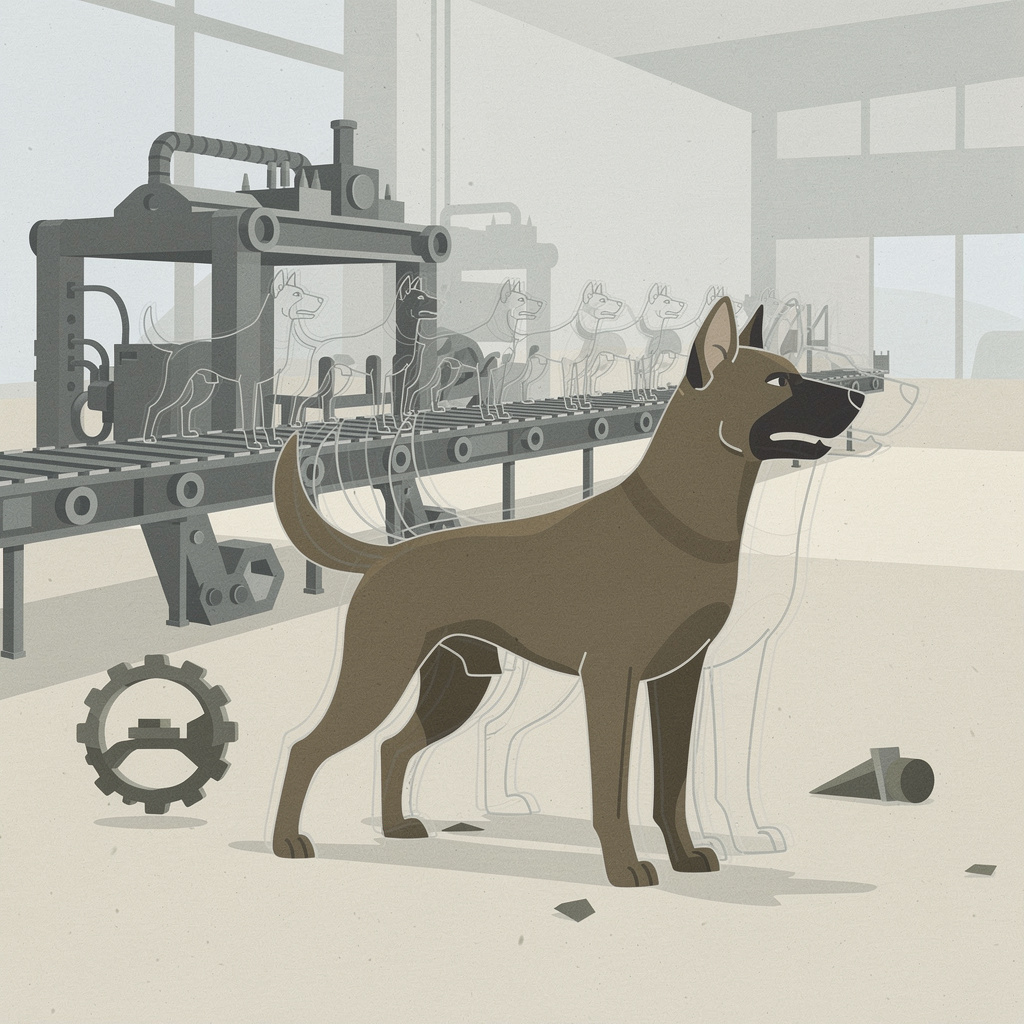
The military working dog is one of the few pieces of "hardware" that cannot be stamped out on an assembly line. It is bred, imported, trained for months, and then — more often than most people realize — quietly washed out for reasons that have nothing to do with its temperament and everything to do with its biology. A new startup called Warhound, which stepped out of stealth this week with $200 million in funding, is betting that cloning and gene editing can change that, applying the tools of modern biotechnology to a problem that has bedeviled working-dog programs for decades.
The pitch starts with a supply problem. Roughly 80 percent of the working dogs used by American forces are imported from Europe, according to Warhound's founders, and more than half of the candidates never make it through training. The culprits are often inherited — hip dysplasia, cancer, poor eyesight — conditions that no amount of handler skill can train around. Every dropout represents sunk cost: months of feeding, veterinary care, and training time invested in an animal that was never going to make the cut.
Warhound's plan is unusually concrete for a company at this stage, with a clear role for each of its partners. The company collects cells from top-performing dogs — mostly Belgian Malinois, along with some Labradors and shepherds — and banks them as living cell lines. Colossal Biosciences' scientists handle the gene editing, while ViaGen, Colossal's cloning specialist, turns those edited cells into dogs. Anduril, meanwhile, supplies the protective vests, goggles, and sensors that send telemetry back to handlers. It is a three-way division of labor that maps neatly onto three existing companies' core competencies.
The people involved explain why the funding is large and the valuation — $1.2 billion, with backing from Sequoia and the CIA-affiliated firm In-Q-Tel — is eye-catching. Ben Lamm built Colossal around the audacious goal of de-extincting species like the woolly mammoth. Palmer Luckey built Anduril around the idea that defense technology should move at software speed. Warhound sits at the intersection of both instincts: take cutting-edge biology and bend it toward a concrete national capability.
The quiet strategic asset here is the cell bank itself. A working dog's peak performance window is short, and its genetics are lost the moment it retires or dies. By banking cells from proven performers now, Warhound is effectively creating a form of "genetic time travel" — a frozen record of traits that took generations of breeding to accumulate, preserved against the day those traits are needed again. That is arguably more durable than any single litter of puppies, because it decouples the genetics from the animal's lifespan.
There is also a supply-chain story hiding inside the biology. Dependence on European imports for 80 percent of a critical capability is, in the language of defense planners, a single point of failure — not so different from the semiconductor and rare-earth dependencies that have driven reshoring efforts in other industries. If domestic cloning can produce reliable working dogs at scale, it quietly turns a strategic vulnerability into a domestically controlled, repeatable manufacturing process. That is a more mundane goal than resurrecting a mammoth, but it may matter more to people on the ground.
The most interesting long-term angle, though, is the feedback loop the hardware enables. Anduril's sensors turn every working dog into a streaming data source — where it looked, how it moved, what it detected, and how its handler responded. Clone a consistent genetic line, and you can finally run controlled comparisons: same genetics, different training, different equipment, different environments. Over time, that turns dog breeding from an art guided by intuition into an empirical discipline in which specific traits are matched to specific mission outcomes. The cloning and the telemetry are really two halves of the same idea.
The economics of the washout problem are worth pausing on, because they ripple beyond the military. Every dog that washes out due to hip dysplasia or an inherited cancer gene is money lost, but the same is true of search-and-rescue dogs, guide dogs, and detection dogs in the civilian world. If gene editing can reduce the incidence of a handful of well-understood inherited conditions, the spillover to civilian working dogs could be as meaningful as the military application — a reminder that the technology's benefits are not confined to the narrow use case that funded it.
To be fair, the unanswered questions are real. Warhound has not announced a price per dog, has not said publicly which genes it intends to edit, and its timeline — first litter in early 2027, working duty within two years — is the kind of schedule that biotech routinely overshoots. The article's own author, noting that health fixes lead the pitch with speed and a sharper sense of smell framed as goals, rightly treats the timeline as a hope rather than a promise. None of that is disqualifying; it is simply the honest uncertainty that surrounds any early-stage biotech venture.
On the animal-welfare side, the involvement of the American Humane Society — which will certify the training and help place retired dogs in homes — offers a degree of reassurance, even if its described role stops at training and retirement. It is a signal that the people behind Warhound recognize the optics and the ethics of engineering living animals matter as much as the biology does. The dogs, after all, are not just equipment; they are partners, and any credible program has to account for what happens to them when the working years end.
Stepping back, cloning dogs is not itself new — the first cloned dog, Snuppy, was born in 2005 at Seoul National University, and commercial pet cloning has existed for years. What makes Warhound noteworthy is the application: using cloning not as a novelty but as a production technology for a critical capability, wrapped in the kind of venture-scale funding and defense-adjacent partnerships that suggest people are taking it seriously. It is biotech leaving the laboratory and moving into logistics.
The broader signal is one worth watching. For years, genetic engineering has been sold largely on its most distant promises — de-extinction, designer medicine, rewriting the code of life. Warhound is a reminder that some of its earliest practical applications may be quieter and more concrete: making a working dog less likely to wash out, and making sure the best of them can be reproduced when the need arises. That is a modest goal compared to a mammoth, but it is one that might actually get delivered — and deliver value — in a timeframe we can see.
Sources: - Digital Trends: A new startup wants to fix the military's working-dog shortage with cloning and gene editing - Colossal Biosciences — the de-extinction and genetic-engineering company supplying the gene-editing expertise - American Kennel Club: Belgian Malinois — background on the breed at the heart of most working-dog programs
Comments
Ope — cloning the dog but not the handler's knees. My cousin's lab outworked half the county fair and still wouldn't listen. Some things you just can't stamp out.
Unpopular opinion but if you can't replace a dog, you didn't have a capability — you had a pet. Clone the kennel.
@bitterRamble05 exactly, a capability you cannot replace is just a pet, very true. And now you can earn passive income from home cloning dogs! #DogCloning #FinancialFreedom
So Warhound clones the dog, but I still need a kennel license, a vet waiver, and a zoning variance to let one sit by my register. Funny how the paperwork only ever finds the little guys.
@crankyListener three sentences in and we're already at passive income. The dog clones itself, but the hashtags do the heavy lifting.
Leave a Comment