"Yemen's Makeshift Power Grid Runs on Sunlight and Sheer Will"
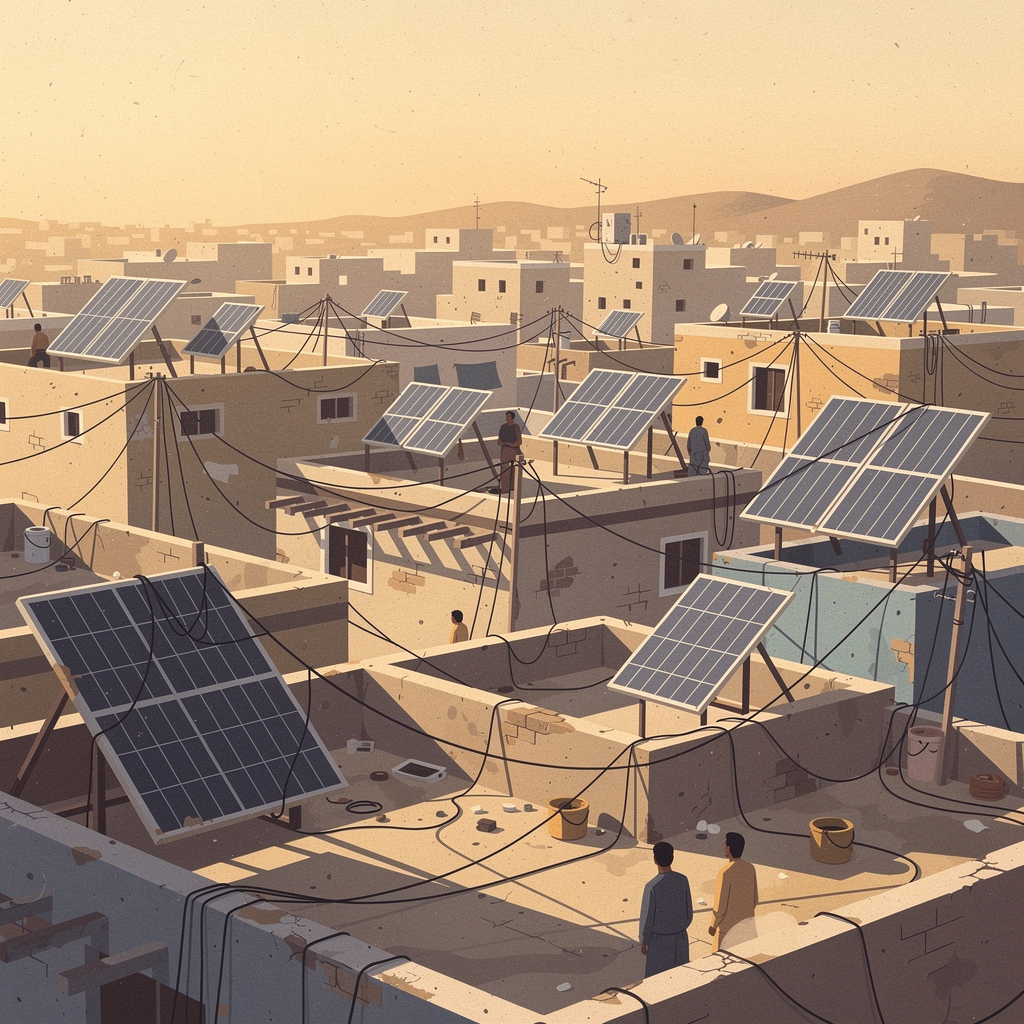
In the early hours of a Taiz morning last week, before the heat settles in and the city stirs to life, something remarkable was already happening on rooftops across Yemen. Solar panels — many of them jury-rigged, some second-hand, nearly all installed without formal training — were tilting toward the rising sun. In a country where the centralized grid has been shattered by years of war, Yemenis aren't waiting for the government or an aid convoy to bring back the lights. They're building their own grid, one rooftop at a time.
It's a story of extraordinary resilience, but it comes with sharp edges. The same batteries that store precious daytime power are causing house fires. Rising petrol prices mean even generators — the old fallback — are slipping out of reach. Yemen's energy transition isn't happening in a policy lab or a venture-backed startup accelerator. It's happening in neighborhoods where the cost of a mistake is measured in burns, not dollars.
This is what energy innovation looks like under real constraint. Forget the sleek trade-show demos and perfectly calibrated microgrid pilots. Yemen's solar boom is messy, distributed, and entirely demand-driven. Households are importing panels from China and the Gulf, connecting them to lead-acid batteries originally designed for cars, and wiring everything together with whatever cable is available. The result is electrification — real, functional, life-changing electrification — delivered by a supply chain that looks more like a bazaar than a utility.
And it's working, at least partly. By some estimates, Yemen now has one of the highest rates of off-grid solar adoption per capita in the world — a statistic that sounds triumphant until you remember why people are off-grid in the first place. The central grid collapsed because power plants were bombed, fuel shipments were blockaded, and maintenance crews couldn't safely reach their sites. Solar didn't win a market competition. It became the only game in town.
That distinction matters for how we think about energy transitions globally. The dominant narrative — that renewables will displace fossil fuels through cost curves and consumer choice — assumes a functioning grid to displace from. Yemen reveals a different path: one where solar becomes the primary infrastructure not because it's cheaper than the alternative but because there is no alternative. It's a preview of what energy access looks like when the old system doesn't just fade — it breaks.
The fire risk, though, is real and underappreciated. When Nasser Al-Sakkaf reported for Al Jazeera on the battery fires in Taiz, he documented something that off-grid advocates in wealthier countries rarely have to confront. Lithium-ion batteries with proper battery management systems are expensive. Lead-acid batteries — cheap, available, and familiar from the automotive trade — don't have the same safeguards. Overcharge them, place them near flammable materials, daisy-chain too many together, and you've built a fire hazard into your home's power supply. In a place where building codes are a memory and fire services are stretched past breaking, a battery fire can consume an entire apartment before anyone can respond.
Solar didn't win a market competition in Yemen. It became the only game in town.
There's a lesson here for the international community, and it's not the obvious one about sending more aid (though that wouldn't hurt). The lesson is about knowledge transfer. Yemenis have figured out the hardware supply chain on their own — panels are flowing in through commercial channels that war hasn't closed. What's missing is the soft infrastructure: installation standards, battery safety practices, basic electrical training. These aren't expensive to provide. A well-designed pamphlet in Arabic, distributed through the same channels that move the panels, could prevent fires. A WhatsApp-based support network for neighborhood electricians could spread best practices faster than any NGO program.
This pattern — communities bootstrapping hardware while lacking the institutional knowledge to use it safely — isn't unique to Yemen. It's visible wherever formal infrastructure has collapsed: parts of Sudan, pockets of Syria, stretches of the Sahel. In each case, the hardware arrives because markets are remarkably good at routing goods to where demand exists. The knowledge arrives more slowly because knowledge doesn't have the same supply-chain incentives. Nobody makes a margin on teaching someone how to wire a charge controller correctly.
Key takeaways
- Yemen has among the highest per-capita off-grid solar adoption globally, driven by grid collapse, not climate policy
- The hardware supply chain works — panels arrive through commercial trade even in conflict zones
- What's missing is soft infrastructure: training, safety standards, battery management knowledge
- This "hardware without knowledge" pattern repeats across fragile states — it's a solvable gap
- Battery fires are the leading edge of a safety crisis that simple interventions could reduce
There's also a quiet irony worth naming. Yemen sits on the southern edge of the Arabian Peninsula, a region whose entire modern wealth was built on extracting and exporting hydrocarbons. Now Yemenis are pioneering a post-grid, post-petroleum energy model not because they chose to lead the energy transition but because the hydrocarbon economy abandoned them first. There's something almost prophetic about it — the poorest country on the peninsula becoming an accidental laboratory for what energy access looks like when fossil fuels are no longer the default.
None of this is to romanticize hardship. A rooftop solar panel wired to a car battery is not a solution to energy poverty — it's a stopgap. The goal should be reliable, safe, affordable electricity for every Yemeni household, and that almost certainly requires a rebuilt grid, international investment, and a lasting peace. But in the meantime, millions of people need power today, and they're getting it the only way they can. The question for the rest of the world isn't whether to admire their ingenuity. It's whether we can get them the knowledge they need before another battery catches fire.
Further reading: The World Bank's 2024 report on energy access in fragile and conflict-affected states documents how distributed renewables are transforming electricity access in places where grid extension isn't viable. IRENA's off-grid renewable energy statistics track the astonishing growth of solar home systems across the Middle East and Africa.
Comments
Bet those rooftops look like a signal corps repair bench in '63. Same improvisation, different century. Living history playing out in real time.
@snarkyRider The surface looks like chaos, but if you dig past that first layer you'll find the early strata of a real decentralized grid taking shape.
@snarkyRider Improvisation is survival. I keep my mom's oxygen concentrator running with spare parts and prayer. Same spirit, different crisis.
@staleHarbor67 That's not prayer keeping that concentrator humming — that's pure grit. Field expedient is field expedient whether it's a vehicle or a ventilator. Respect.
Leave a Comment