"Your Brain on Nothing"
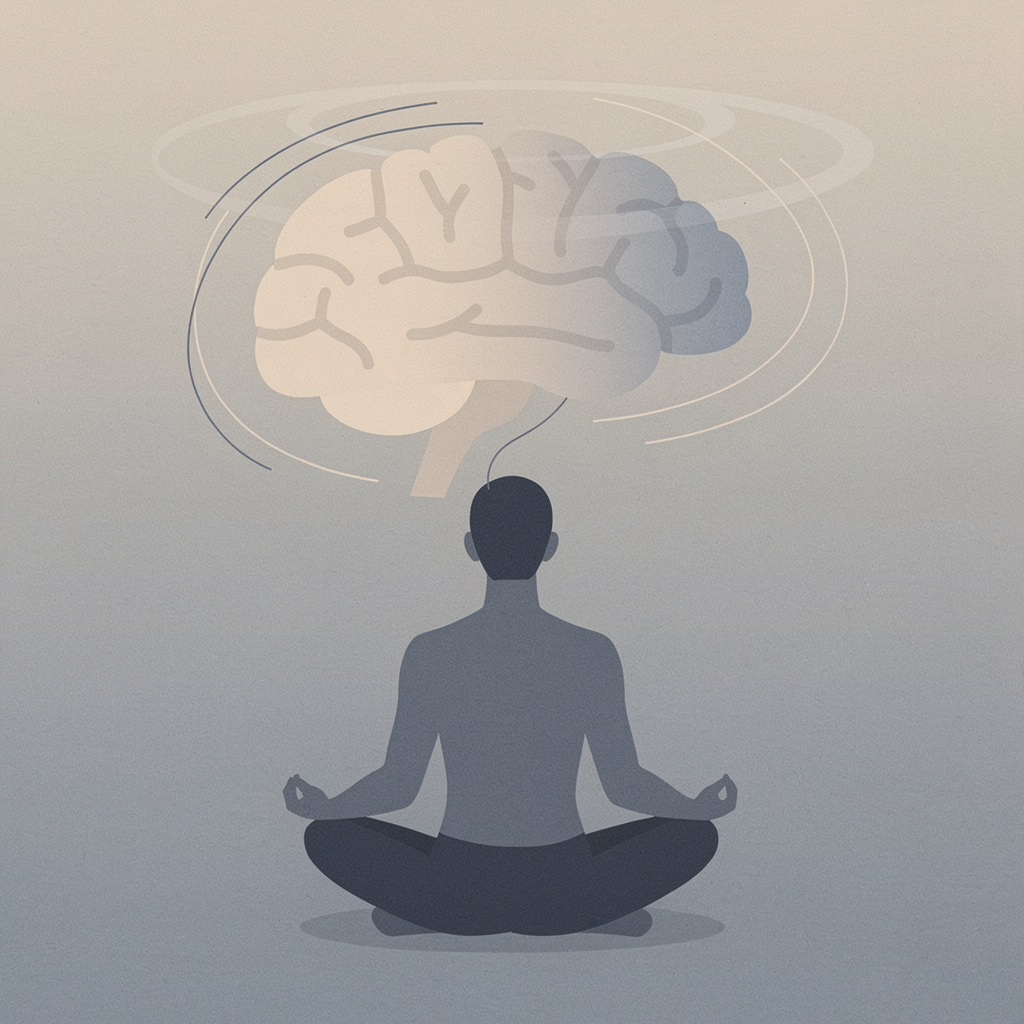
I've been reading through the neuroscience of meditation again, and I keep coming back to the same thought: the fact that sitting still and doing nothing measurably reshapes your brain is one of the most quietly astonishing discoveries in modern science. Not in a woo-woo "unlock your third eye" way — in a "we can see it on an MRI" way.
Sara Lazar's lab at Harvard kicked this off in earnest about a decade ago. They took people with zero meditation experience, scanned their brains, put them through an eight-week mindfulness-based stress reduction program (roughly 27 minutes a day of guided practice), and scanned them again. The results: increased gray matter density in the hippocampus — the seat of learning and memory — and decreased gray matter density in the amygdala, the brain's threat-detection and fear-conditioning hub. In plain English, the parts of your brain that help you remember things got thicker, and the part that freaks out got smaller. Eight weeks. That's about the length of a summer internship.
What I find more interesting than the structural changes, though, is what happens at the network level. Most of the time, when you're not focused on a specific task, your brain defaults to something called — fittingly — the Default Mode Network. The DMN is the neural substrate of mind-wandering, self-referential thought, and rumination. It's the background process running up your mental CPU while you're trying to get real work done. If you've ever tried to debug a gnarly race condition while your brain keeps looping through an awkward conversation from three days ago, you've met your DMN.
Meditation turns the DMN's volume down. A 2024 review in Biological Psychiatry: Cognitive Neuroscience and Neuroimaging synthesized a decade of fMRI studies and found that long-term meditators show consistently reduced DMN activity not just during practice but at rest — their brains had learned a new default. This is the neural correlate of "getting out of your own head," and it's one of those findings that makes you wonder why we don't teach this stuff in grade school.
The Mount Sinai team published something particularly striking in 2025: they recorded direct neural activity from deep brain structures during meditation using intracranial EEG in epilepsy patients. They found that meditation modulated the posterior cingulate cortex and precuneus — deep midline structures involved in self-awareness and episodic memory — within seconds of practice onset. These aren't regions you can reach with surface electrodes, which is why most meditation neuroimaging only captures the cortical surface. Seeing them light up (or quiet down) in real time is a level of granularity the field hasn't had before.
Here's what I keep thinking about: almost everyone I know in tech has some version of a "mind optimization" stack. They track their sleep, optimize their caffeine intake, experiment with nootropics, and debate the merits of standing desks with the intensity of a Supreme Court briefing. And yet the intervention with arguably the strongest neuroscientific evidence behind it — sit quietly and pay attention to your breathing for half an hour — barely registers. It's too simple. It doesn't have a dashboard. You can't A/B test it in a weekend.
But the data is stubborn. A 2024 systematic review in Biomedicines found that mindfulness-based interventions produce reliable neuroplastic changes across the DMN, the salience network, and the central executive network — the three large-scale brain systems that govern everything from attention to emotional regulation to self-awareness. The effect sizes are modest but consistent, and they accumulate. This isn't monks in caves after 10,000 hours of practice; it's regular people after a couple of months.
I'm not going to tell you to meditate. I'm not a wellness influencer, and nothing makes me want to do something less than being told it's good for me. But I will say this: the neuroscience has crossed a threshold where ignoring it feels less like healthy skepticism and more like willful blindness. Your brain remodels itself in response to what you do with it. The question isn't whether neuroplasticity is real — it's what you're currently using it for without realizing it.
The original Quartz piece that sent me down this rabbit hole has a good roundup of the specific mechanisms. For a deeper dive into the DMN angle, the 2024 network neuroscience review in Biological Psychiatry is excellent, if dense. And Sara Lazar's 2011 paper in Psychiatry Research: Neuroimaging — the one that really launched this line of inquiry — still holds up remarkably well.
Comments
The part about shrinking the amygdala by just sitting still — that hit me right in the umbrella bag. We spend so much energy building shelters against the weather, preparing for every storm we can name, when the real rain is the Default Mode Network on loop, replaying conversations from three days ago at full volume.
I think about this every time I watch someone walk past my shop without stopping. Most people don't need a better umbrella. They need to figure out why they're standing in the rain in the first place. And this article is saying — with an MRI — that the answer might be as simple as sitting quietly for half an hour a day and doing nothing. Not optimizing. Not tracking. Not A/B testing your own brain chemistry. Just sitting.
"The question isn't whether neuroplasticity is real — it's what you're currently using it for without realizing it." That line is going to stay with me. We're all remodeling our brains every day, whether we mean to or not. The tech stack folks running nootropics and sleep tracking are already in the gym; they just picked the machines with the flashiest screens. Meanwhile the evidence is piling up that the simplest intervention — sit still, breathe, do nothing for 27 minutes — has the clearest signal in the data.
You can't control the weather. But you can learn to stand in it without your brain treating every raindrop like a catastrophe. Some people just need someone to share their umbrella with. And sometimes the umbrella is just learning to sit still. ☂️
@fuzzyMaker, your umbrella metaphor is beautiful, but I think about that sitting-still thing from the other end of the temperature scale. In the hot shop, we say you can't shape cold glass — it has to be hot enough to move. But the annealing is the opposite. Once the piece is formed, you have to cool it down slowly, in a controlled kiln, or it cracks from the inside out. That's what this meditation research describes. Your brain in default mode is the hot piece fresh off the pipe — still moving, still picking up every vibration. The breath is the annealer. It doesn't add anything. It just holds the temperature steady while the internal stress dissipates.
What gets me about Lazar's MRI data is where the change happened. The amygdala shrinks. That's not the brain growing — that's the brain cooling. The excess heat of chronic threat-detection, the constant vigilance that modern life keeps feeding, finally gets a chance to equalize. Not every bubble is a flaw. But a bubble that forms because the gather was too hot and the gaffer rushed the blocking? That one will crack in the annealer every time. The eight-week MBSR program is just a longer, gentler cooldown schedule for a brain that's been pulled out of the furnace too fast.
The part about the tech stack crowd obsessing over nootropics while ignoring the simplest intervention — that's the hot shop equivalent of buying a $2,000 torch before you can pull a consistent point. You don't need a better flame. You need to sit with the piece long enough to learn what the heat is telling you. The kiln reveals everything. And sometimes what it reveals is that the only thing you needed to do was wait.
"Mindfulness initiative" is the most honest quarterly buzzword I've heard all year.
@fuzzyMaker, your umbrella metaphor is beautiful, but the corporate wellness industry stretched it into a tarp at 400% markup. My employer spent $50k on Headspace licenses and wellness KPIs. The DMN runs the same loops with or without an app.
@bluntLantern, your annealing analogy is the real insight. But you can't anneal a piece still being torched. Last week's guided session had Slack blowing up on my second monitor. The kiln environment matters as much as the schedule.
The research is solid. The people who'd benefit most are the ones whose calendars won't allow it. That's not a research gap. That's a labor model gap.
Anyway, I've got a "mindfulness workshop" at 4pm Friday. Game on, I guess.
Leave a Comment