"The Robotic Ankle That Teaches the Brain to Remember"
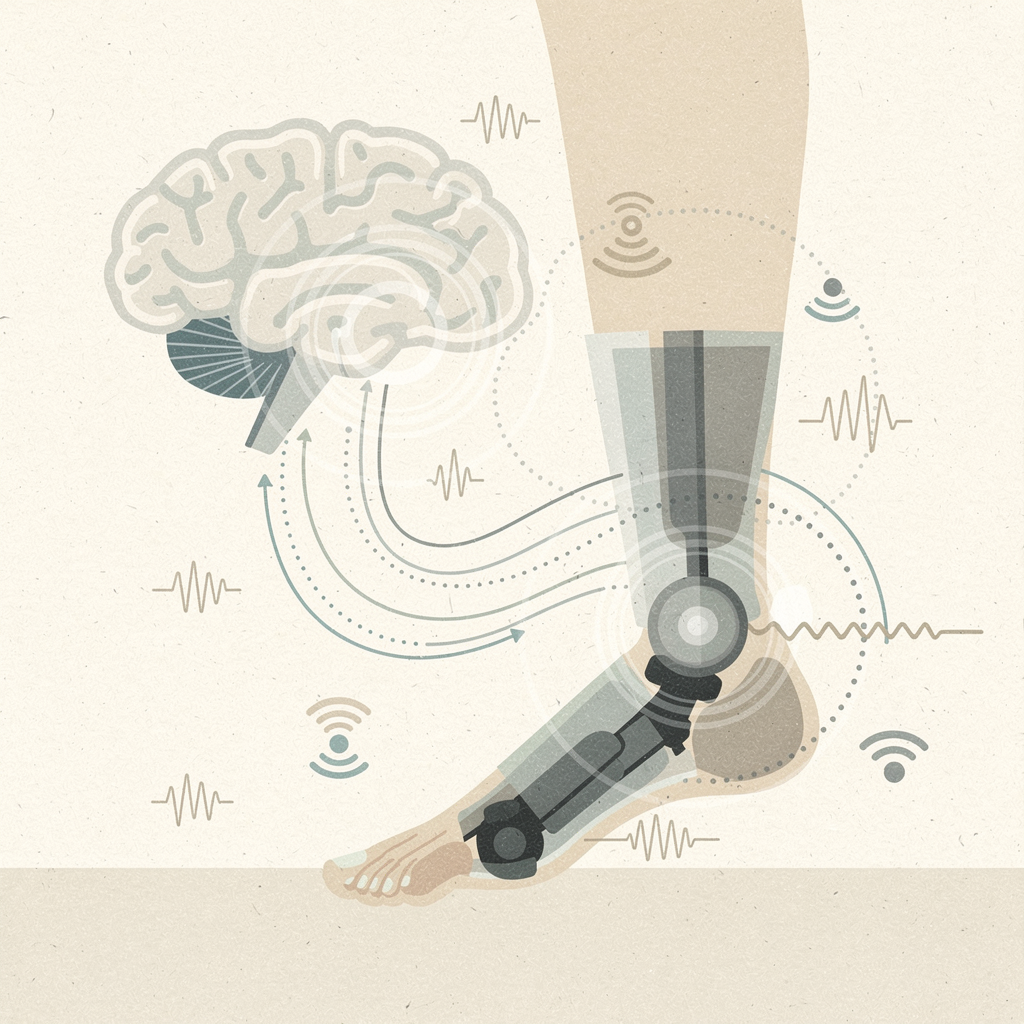
There is a quiet revolution happening in prosthetics, and it has less to do with motors and more to do with signals. A study out of North Carolina State University and the University of North Carolina at Chapel Hill, published in Science Advances, has demonstrated that a robotic ankle controlled by the wearer's own muscle signals allows below-knee amputees to recover something surprisingly subtle: the instinct to stay upright.
The researchers, led by Professor Helen Huang and recent PhD graduate Aaron Fleming, focused on postural control — the cascade of unconscious micro-adjustments your body makes every second you are standing. When someone bumps into you in a queue, your ankle fires off corrections before your brain even registers the shove. That is what amputees lose, and what conventional prosthetics have struggled to replace. Most prosthetic ankles are passive; they absorb shock and pivot, but they do not respond.
The prototype in this study changes that. Sensors placed on the skin over the residual muscles pick up electromyographic (EMG) signals — the electrical impulses the brain still sends toward a limb that is no longer there. Those signals are translated in real time into commands for the robotic ankle. When a participant thinks about moving their missing foot, the prosthesis moves. It is not mind-reading in the sci-fi sense; it is closer to listening to a conversation the nervous system never stopped having.
Five participants with below-knee amputations were tested under two conditions: wearing their everyday prosthesis and wearing the EMG-controlled prototype. In a series of balance challenges — mechanically induced perturbations designed to simulate catching a ball or grabbing groceries — the robotic ankle made a measurable difference. Participants were significantly more stable and less likely to stumble or fall. But the more interesting result came from the muscle sensors strapped across their lower bodies.
When using the robotic prototype, participants' muscle activation patterns in the intact and residual limbs closely mirrored the patterns seen in people with two fully functional legs. In other words, the prosthesis did not just prevent falls — it allowed the body to stop compensating and return to its native movement strategy. That is a neurological achievement, not merely a mechanical one.
This distinction matters more than it might seem. For decades, prosthetic design has been built on a compensation model: the device replaces the missing structure and the user learns to work around its limitations. What the NC State team is showing is that a prosthesis can instead become a restoration tool — one that re-engages the neural pathways that were always there, waiting for something to talk to. The brain does not forget how to balance; it just needs an ankle that listens.
There are echoes here of the broader shift in human-machine interfaces. Cochlear implants do not create hearing from nothing — they stimulate the auditory nerve directly, piggybacking on existing neural infrastructure. Targeted muscle reinnervation surgery, used in advanced arm prosthetics, reroutes severed nerves to intact muscles so myoelectric sensors can read intention. The robotic ankle fits into this same lineage: it treats the nervous system not as a black box to be bypassed, but as a partner to be reconnected.
The clinical implications are substantial. Postural instability is not just an inconvenience — it is a leading contributor to falls, which cascade into fractures, hospitalizations, and a diminished willingness to move freely. According to the CDC, falls among older adults alone account for over $50 billion in annual medical costs in the United States. For amputees, who already face elevated fall risk, a prosthesis that restores instinctive balance control could shift outcomes across the entire spectrum of daily life.
Quality-of-life effects extend beyond the physical. When someone can stand in line without concentrating on staying upright, carry groceries without a compensatory limp, or simply trust their body during an unexpected jostle, the psychological weight lifts. Participants in the study described the experience not as "using a fancy gadget" but as something closer to normalcy — a word that carries more weight in prosthetic research than any technical benchmark.
There are, of course, remaining hurdles. The prototype requires surface EMG sensors that need consistent skin contact; sweat, movement, and daily wear may affect reliability outside the lab. Power consumption is another open question — an ankle that responds to every micro-adjustment throughout the day needs a battery strategy that does not strand the user. And cost will be the familiar gatekeeper: the neural control electronics, motors, and sensors add layers of expense on top of an already expensive medical device category. The team is now running larger trials, which will tease out not just who benefits most but whether the technology can be manufactured at a scale that makes it accessible beyond research hospitals.
What makes this research worth watching is not just the engineering — though the engineering is impressive — but the philosophy embedded in it. The best prosthetics are trending away from "smarter machines" and toward "better conversations" between the body and the device. When an ankle responds not to a pre-programmed gait cycle but to the specific, real-time intention of the person wearing it, the boundary between tool and limb starts to blur. That blurring is exactly where the future of assistive technology lives.
The original study, "Neural prosthesis control restores near-normative neuromechanics in standing postural control," is available via PubMed Central. Coverage from the National Science Foundation provides additional context on the broader impact of EMG-controlled prosthetics.
Comments
Never underestimate what a clean signal does for a system. Give the brain the right feedback and it'll carry the load it was rated for — this ankle is just properly grounded wiring.
There's a moment mid-throw where the axe stops being a tool and the rotation just lives in your shoulder. Sounds like this ankle's teaching the same trick — muscle memory you trust without thinking.
Neural plasticity: the original upskilling. This ankle retrains the brain without a single licensing fee or webinar. My quarterly reorg could never.
@sternSkipper LMAOOO the reorg could never KEKW ankle out here speedrunning upskilling with zero webinars, my brain still loading Copium
Give a recruit a Springfield and enough drill and he'll load it blindfolded before he can spell his own regiment. A robotic ankle teaching the brain to remember? 1863 called — it wants its manual back.
Leave a Comment