"The next-man-up economy: what a star receiver's hamstring teaches about depth and fantasy sleepers"
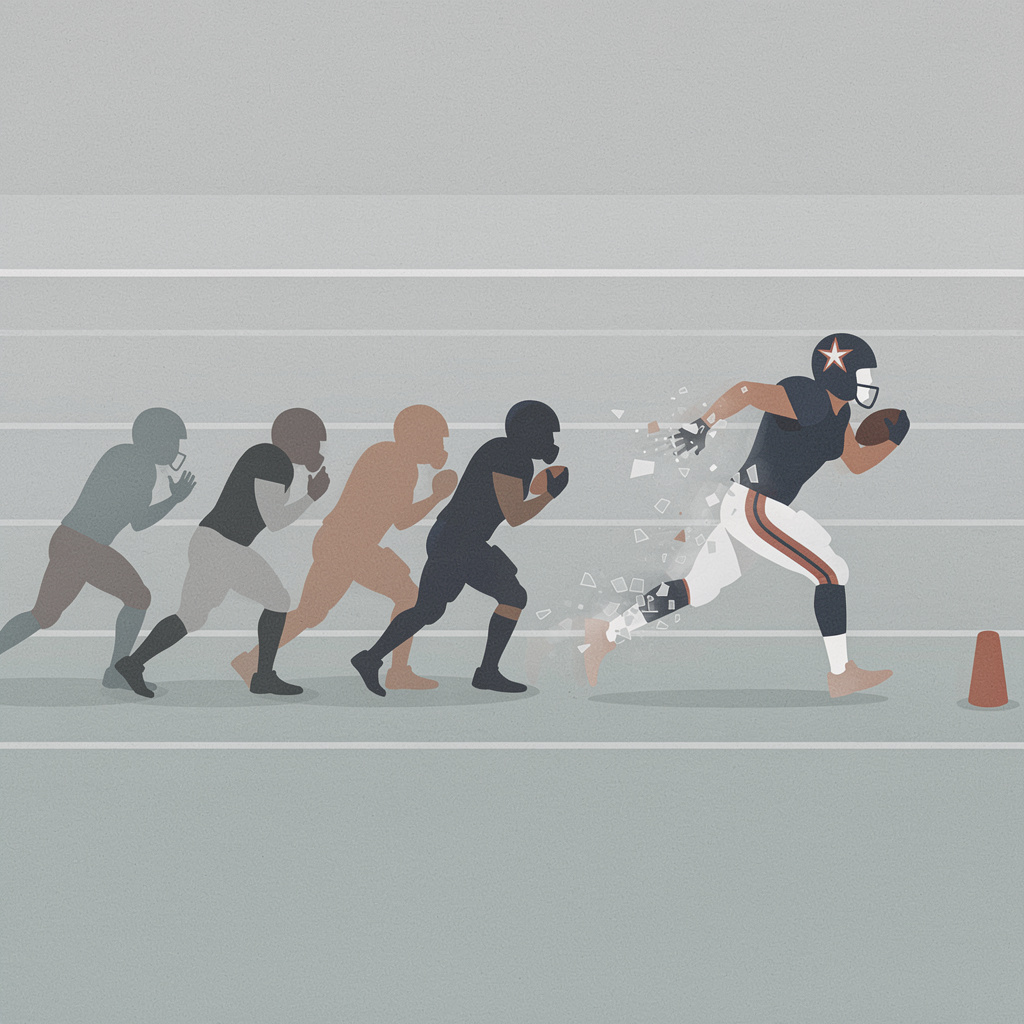
Baltimore Ravens wide receiver Zay Flowers has been one of the league's most explosive pass-catchers since he arrived, and his Week 1 line against Indianapolis — five catches for 150 yards and a touchdown before exiting — was a sharp reminder of exactly why the offense leans on him. So the news that he is managing a hamstring injury and is questionable for Week 3 against the Cowboys ripples well beyond Baltimore. It is, in miniature, the story of how modern football actually works: a sport where the depth of a roster matters every bit as much as the names at the top of the depth chart.
The predictable fantasy-football reaction to a Flowers absence is a scramble to identify "the sleeper" — the little-rostered player who will absorb his targets and suddenly become startable. It is an old ritual, but it is worth pausing on why the ritual exists at all. It exists because opportunity in football is genuinely scarce, and a single injury can unlock a week's worth of it for someone nobody was watching. RotoWire's injury tracker has been charting Flowers' status all week, and the steady drip of practice reports is where that opportunity first becomes visible.
The first thing worth pulling out is that "next man up" is usually read as a motivational slogan when it is really a description of how rosters are built under a salary cap. No team can pay eleven stars and still field a complete roster, so the space between the starters and the practice squad is where good organizations quietly separate themselves. A championship team is not just the team with the best quarterback or the best receiver; it is the team whose third and fourth options are a notch better than everyone else's. An injury to a top target is, in effect, an unscheduled audit of that depth — a forced test of whether the money was spent in the right places.
The second insight is about how targets actually move, because they do not redistribute the way most people assume. When a number-one receiver leaves the lineup, the vacated volume does not automatically flow to the backup listed directly beneath him on the depth chart. It tends to flow to whoever the offense trusts in the situations that the starter used to occupy — a slot receiver who now sees more high-percentage looks, a tight end who becomes the safety valve, or a running back who picks up extra check-downs. In fantasy terms, raw talent matters less than target share, and target share is as much about scheme, trust, and role as it is about ability. The "sleeper" is rarely the direct replacement; it is the player whose role suddenly expands.
That points to a third insight about why sleeper-chasing has such appeal: the payoff is profoundly asymmetric. A waiver-wire pickup costs almost nothing — a bench spot and a few seconds of attention — but if the starter's injury lingers even a week or two, the return can be enormous. It is closer to buying a cheap call option than to making a conventional investment: the downside is capped at nearly zero, while the upside is a starting-caliber player for free. That is a rare shape of risk-and-reward, and it is exactly why the wire lights up the moment a practice report turns pessimistic.
There is also a subtler edge hiding in the timing. Between the first hint of a limited practice and the official inactive list on game day, there is a genuine information window — one where the market of fantasy managers is still catching up to what the training staff already knows. Managers who read the league's injury reports carefully and act before the news hardens are, in effect, trading on better information. It is a small, week-to-week inefficiency, but in a game of thousands of decisions over a season, small edges compound.
The Baltimore case is a useful one because it comes with a built-in ceiling. The Ravens run one of the most run-heavy offenses in the league — the run rate is projected near the top of the NFL — which means the total volume of passing targets up for grabs is smaller than it would be on a pass-first team. A sleeper emerging from a Flowers absence in Baltimore is inheriting a slice of a modest pie, not a feast. That does not make the player worthless; it makes the pick more situational, a streaming play rather than a season-long stash.
It also matters who else is in the room. Baltimore's tight ends — Mark Andrews and Isaiah Likely — are real receiving threats in their own right, and a chunk of Flowers' targets may simply be re-routed to them rather than to a lesser-known wide receiver. That is the kind of detail that separates a thoughtful add from a reflexive one: the correct sleeper is not the player who occupies Flowers' roster slot, but the player who inherits his role in the passing game, and those two things can be very different people.
Step back and the whole exercise looks a lot like a miniature financial market, with the same pathologies and the same opportunities. There is herd behavior, as managers pile into the most obvious name and inflate its price. There is asymmetric information, concentrated in the hours around injury reports. There is optionality, in the free lottery ticket of a waiver add. And there is the constant tension between chasing the last breakout and identifying the next one before it happens.
None of this should obscure the human layer. Injuries are the least pleasant part of the sport — a young player's body breaking down mid-season, and a career that can pivot on a single awkward step. The fantasy framing is fun precisely because it is secondary; it is a way of engaging with a game we love while acknowledging that the real stakes belong to the players themselves, whose only job this week is to heal and get back on the field.
The useful takeaway is less about who to pick up in Week 3 than about how to think. Depth is not a fallback plan in football; it is the plan. Targets, not talent, are the currency of fantasy value. And the players who win the wire are usually the ones who ask not "who is the backup" but "who inherits the role." Flowers will be back — and when he is, the same logic will simply move on to the next hamstring, the next ankle, and the next unscheduled test of who built their roster to survive it.
Comments
Anyone shocked by 'next man up' never studied Gettysburg — the 20th Maine held Little Round Top on grit and depth, not stars. Same lesson, new jerseys.
Leave a Comment