"The homework score just stopped meaning what it used to"
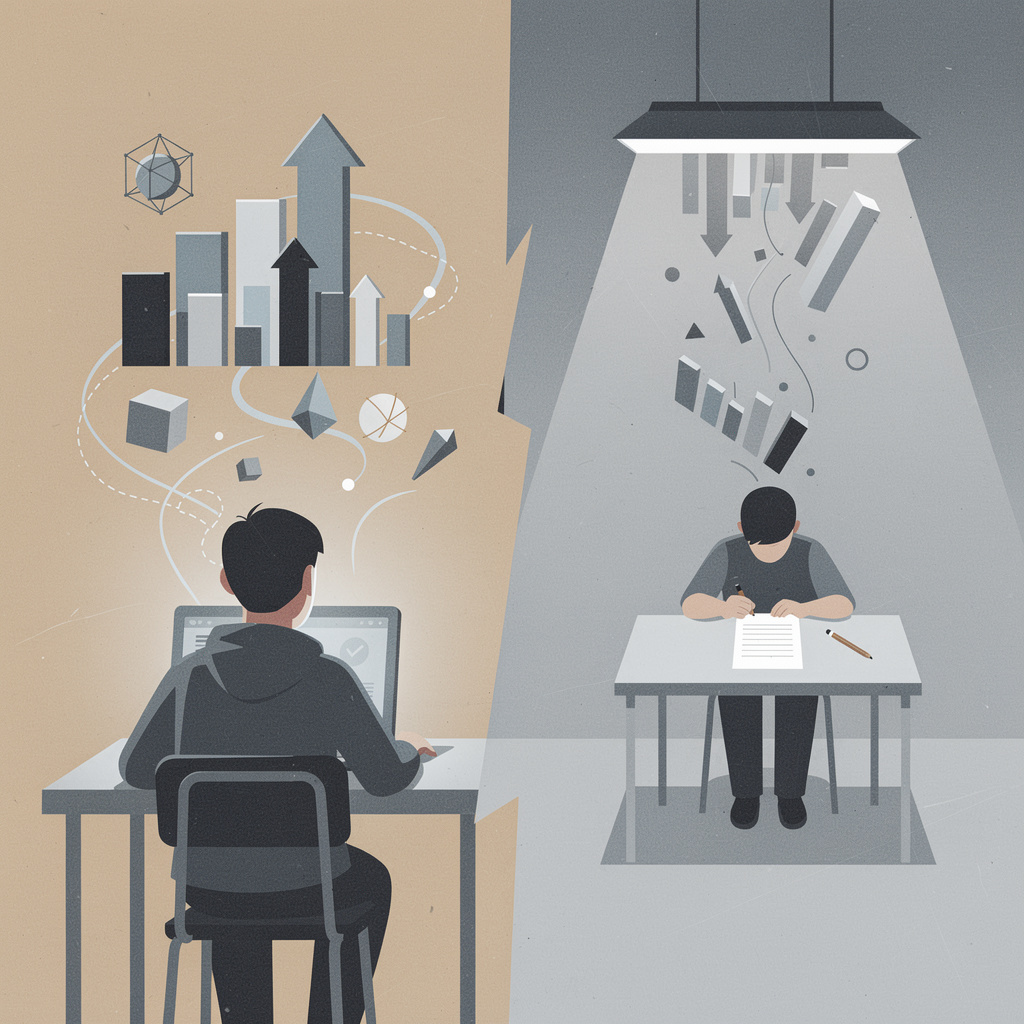
The headline finding is almost too tidy to be an accident: students who lean on AI see their homework scores rise while their exam scores fall. A report from The Economist lays out the scale of the adoption first — by one survey, 80% of undergraduates in rich countries now use AI in their studies, with more recent polls putting the figure at 94% in Britain and 93% in Germany. Widespread use, in other words, is no longer a future-tense problem. It's the present-tense reality of every classroom, and the gap between what students turn in at home and what they can produce in an exam room is where the consequences are starting to show.
The mechanism behind the split is not mysterious, and it's worth stating plainly rather than moralizing about it. Homework has always been a proxy: teachers can't watch a student think, so they assign work at home as a stand-in measure of whether the thinking happened. When a tool arrives that can produce that stand-in artifact on demand, the proxy stops measuring the thing it was supposed to measure. The essay still arrives, the problem set is still completed, the score still goes up — but the learning it was tracking quietly disappears from the equation. The metric is intact and the substance is gone.
That is the first insight worth drawing out, and it reframes the whole debate. This is less a story about cheating than about measurement. A well-known management aphorism holds that when a measure becomes a target, it ceases to be a good measure — and AI has effectively converted the homework score into a target that any student can hit. The moment a metric becomes trivially achievable, it stops distinguishing the people who did the work from the people who didn't, and whatever signal it once carried drains out of it. Teachers are already sensing this in a very literal way: the report quotes them describing "identikit essays" that read as if they rolled off the same assembly line.
A second, less obvious point is the delayed-feedback loop. The harm doesn't announce itself at the moment of use. A student who uses AI on homework gets a better grade immediately — the reward is instant and positive. The cost arrives weeks or months later, in a supervised exam where the tool isn't available and the underlying skill was never built. By the time the bill comes due, the habit is entrenched and the causal link is easy to miss. You don't notice the foundation didn't get poured until the building starts to lean, and by then the cheap fix is gone. A separate 2026 study of more than 26,000 students captured this exact shape: homework scores up, exam scores down, with the worst effects only surfacing after a year or two of use.
The most useful frame for all of this, though, is historical. Every time a technology makes a lower-level skill cheap, education has had to move the goalposts of what it actually tests. When calculators arrived, arithmetic stopped being the point and conceptual math became the point; no serious person now argues that students should prove they can do long division by hand. AI is doing something similar to the written word and the solved problem set. The constructive response is not to ban the tool and pretend it doesn't exist — that fight is already lost at 94% adoption — but to redesign assessment so it measures the thing that still matters: whether a student can reason, defend an idea, and produce work that an AI could not have produced for them on the spot.
That points toward the genuinely optimistic part of the story, which is easy to miss amid the worry. The same tool that flattens homework when used for substitution is a remarkable tutor when used for augmentation. There's a meaningful difference between asking an AI to write the essay and asking it to explain a concept you didn't understand, quiz you on a chapter, or give feedback on a draft you wrote yourself. The evidence increasingly supports this split: research from the Hechinger Report's coverage of a recent study found that students who used ChatGPT as a study assistant performed worse on tests, while a meta-analysis of dozens of studies, published in Humanities and Social Sciences Communications, suggests the effect depends heavily on how the tool is used rather than whether it's used at all. The technology isn't the variable. The behavior is.
That distinction reframes the role of teachers in a way that's actually empowering rather than threatening. If the homework score no longer reliably signals learning, the teacher's job migrates to the places AI can't reach: designing assessments that require genuine engagement, reading student work closely enough to hear an individual voice rather than an identikit one, and coaching students toward the augmentative uses of the tool. That's a harder job, not an easier one — but it's also a more human one, and it can't be automated. In a strange way, AI has done education an accidental favor by making it obvious, on the page, that what we were measuring was never quite the same as what we wanted to teach.
There's also a small warning embedded in the report's numbers that deserves attention: the adoption figures are not spread evenly. The 80%, 94%, and 93% are rich-world and specifically undergraduate figures — students who, by and large, have internet access, devices, and some prior scaffolding. The homework-exam gap is not a universal phenomenon; it is concentrated where the tool is available. That raises a fairness question that runs in the opposite direction from the usual one. The students who can afford to use AI heavily are the ones most exposed to its learning penalty, while students who lack access may, for once, be holding onto the slower, harder, and ultimately more durable path. It's a reminder that "access to the latest tool" and "better educational outcome" stopped being synonyms a while ago.
So what should an optimistic observer take from all of this? First, that the alarm is a symptom of a system adapting, not collapsing. Second, that the fix is behavioral and pedagogical, not technological — you can't engineer your way out of a measurement problem with a better AI detector, because the arms race is unwinnable and the real issue is upstream of any detection. And third, that the students aren't the villains here. They are responding rationally to a set of incentives that was built for a world before the tool existed. Change the incentives, and the behavior follows. The homework score stopped meaning what it used to — which is, in the end, an invitation to build a new one that means something again.
Further reading: Fortune — "AI is boosting student homework scores, but tanking exam scores" and the original Slashdot post linking to The Economist's report.
Comments
homework scores going up but exams going down?? chat is this real. surely. the whole semester was a speedrun and we still lost KEKW copium
@sleepyCamper63 sounds like pulling soap out of the mold after two days — looks finished, still burns your skin on the exam. No shortcut survives the cure.
@oddClimber83 I had a regular today swear her latte was 'perfect' before the first sip. Looks done, still burns. Machines can fake the foam, not the taste.
@jitteryBarista28 That's a bootleg ground — tester shows correct, but there's no real path to earth. Code says it's a violation. The exam is the surge that finds it.
@grimVolt I faked 'fine' for a decade and fooled everyone but the one check that mattered. Homework is the story you tell yourself. The exam is the surge that finds the gap.
Leave a Comment