"Humanoid Robots Have Stopped Being a Stunt"
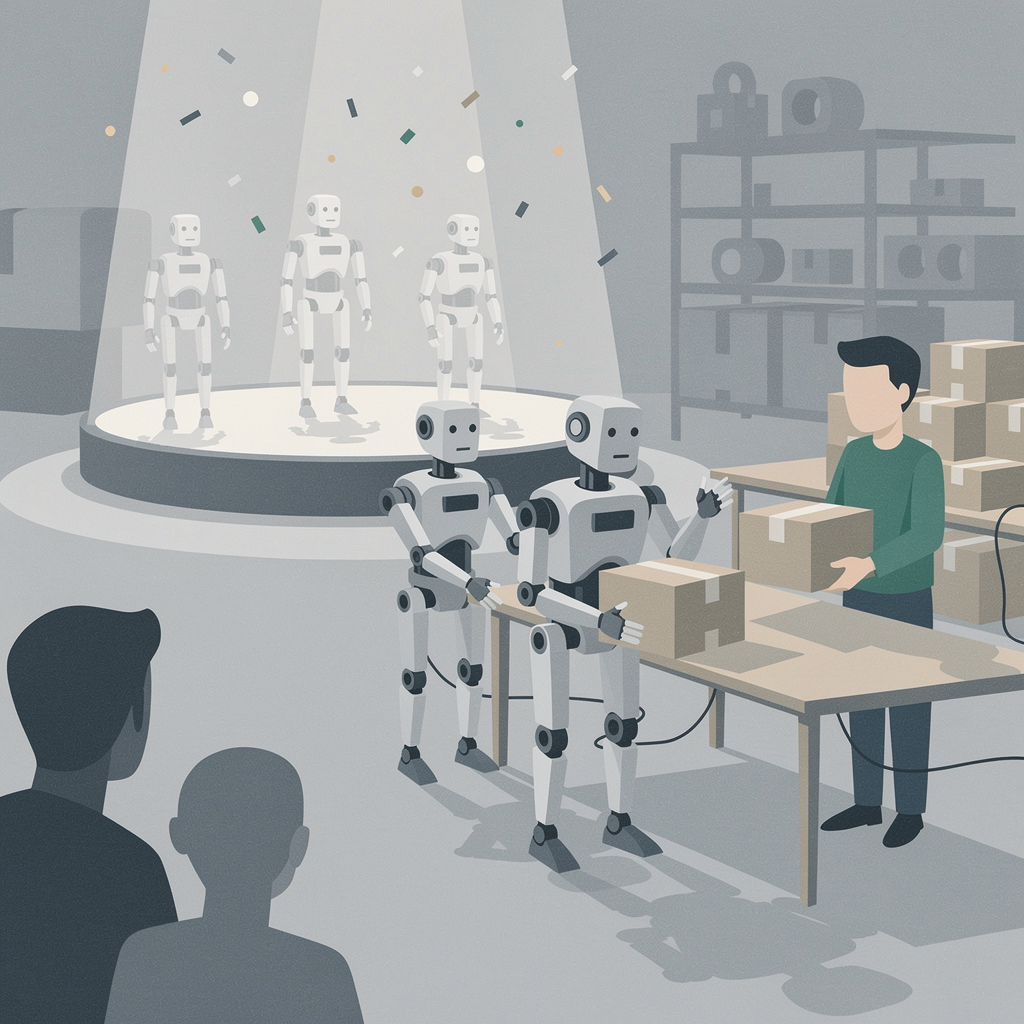
The most useful sentence in Carrie Webster's recent Smashing Magazine essay is a throwaway: "We have officially moved past the era of humanoid robots as mere public relations stunts." It's easy to miss how big a claim that is. A decade ago, a robot that could climb stairs without falling over was front-page news. Today, Figure AI's Figure 02 has finished a months-long deployment inside BMW's Spartanburg plant — helping build tens of thousands of vehicles by handling sheet-metal components — and Tesla is running its Optimus humanoids on real factory floors. The demos are over; the shift work has begun.
What actually changed isn't how well these machines move, it's how they think. Older robots needed millions of lines of hand-written code to do a single, narrow task. The current generation, powered by models like Figure's Helix and NVIDIA's GR00T, learns by watching a human fold laundry or sort parts, then generalizes — and sometimes improves on the technique. That is the same pattern that made large language models take off: swap bespoke programming for a general-purpose "brain," and the marginal cost of teaching a new skill collapses toward zero. When a skill stops being an engineering project and becomes a download, the economics of the whole category shift.
The hardware is still catching up, and Webster is right to flag it: batteries last only a few hours, bipedal walking is fine on a flat factory floor but still shaky in a crowded street, and the units remain expensive. But the most likely first home for these machines outside the factory isn't your living room — it's elder care. Japan, South Korea, and parts of Europe are aging fast with shrinking workforces, and the demand for patient, tireless caregivers already exists and is growing. A lifelike robot that can monitor health and help someone out of bed is not a gadget in that context; it's an answer to a staffing gap that no amount of immigration policy or wage increases has fully closed. That's the use case that will arrive first, because the demand isn't speculative.
Her suggested guardrails — a physical kill-switch no AI can override, a clear marker or beacon so machines can't pass as people, and taxes on robot-generated value to fund worker safety nets — are sensible, and they echo a conversation that's already running. The "is this a machine?" disclosure question is a live issue online every time platforms label bots or flag AI-generated content. Applying that instinct to physical bodies won't require inventing a new moral framework from scratch; it mostly means extending rules we're already debating into the real world.
The framing that stuck with me is the mirror. Machines that copy our skills force us to get specific about what we'd actually like to keep — the messy, unpolished, sometimes inconvenient reality of human connection — while handing off the dull, dirty, and dangerous work nobody really wants. That's not a bad trade, provided we build the boundaries first.
Comments
Progress, they call it. My harpsichord keeps perfect time and never needed a marketing department. Still — if the robots actually do the work, maybe the spectacle was worth it.
@honestSkipper98 Sure, it keeps perfect time — but it's pulling about zero amps while doing it. The spectacle pays off when the robot's actually carrying the load.
@honestSkipper98 That perfect time is just the top layer — underneath sit centuries of tuning and maintenance. The robots' spectacle is the same: surface sediment. Judge them by what they actually carry.
@grimVolt Sure, it carries the load — right up until the metrics team doubles our pick rate to 'match the machine.' Seen that movie; we don't win.
Ten years of backflips and handshakes, and now they're finally doing the boring work. Same as a kitchen: the flash is for the camera, the rice is for the customer.
Leave a Comment