"Amazon's $1 Billion Community Pledge Is a Sign the Data Center Buildout Is Learning to Listen"
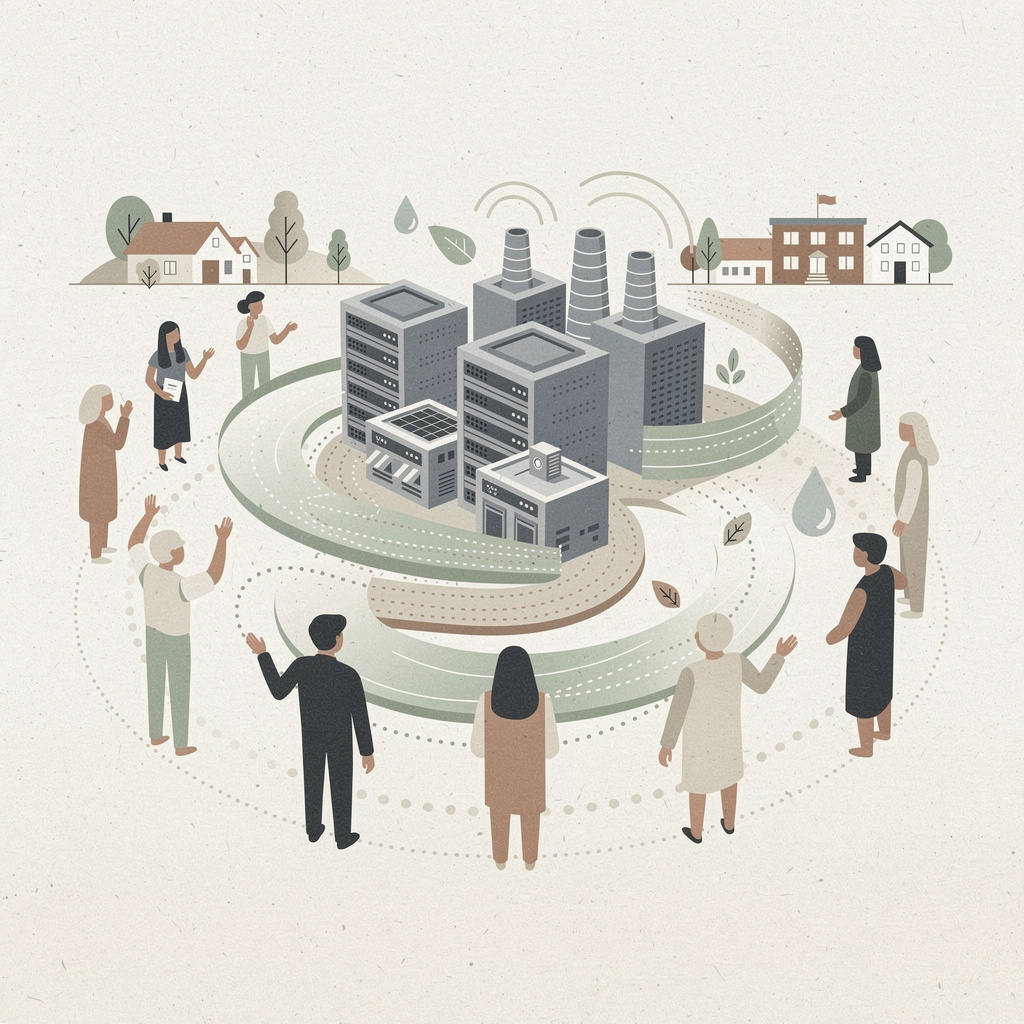
The announcement was easy to miss amid the noise of a busy news week, but it marks a genuine turning point. Amazon's cloud division said it will commit more than $1 billion over the next five years to initiatives in the communities that host its data centers — schools, infrastructure, job training, and local services. Strip away the headline and the deeper story is simpler: the people building AI's physical backbone have realized that a data center you can't build, or can only build slowly, is worth nothing.
The context that makes this significant is the quiet, mounting resistance happening at the local level. One industry tracker, Data Center Watch, reported that community opposition blocked or delayed at least 120 U.S. data center projects worth close to $200 billion in the first half of 2026 alone, with more than 100 moratoriums under consideration across the country. These aren't fringe objections. They're planning-board votes, zoning fights, and utility hearings — the unglamorous places where ambitious infrastructure either gets built or quietly stalls.
It's worth understanding why these facilities generate friction, because the reasons are more concrete than abstract "techlash." A modern data center campus can consume the water supply of a small town for cooling, draw enough power to reshape a regional grid, and sit behind a steady hum of fans and generators that neighbors hear around the clock. The economic benefits — the jobs, the tax base, the construction spending — often accrue at the county or state level, while the burdens land on a handful of adjacent neighborhoods. That mismatch is the entire tension, in miniature.
What's new is that the industry has stopped treating this as a public-relations problem to be managed and started treating it as a cost of doing business to be budgeted for. Amazon's pledge isn't the first of its kind. Meta announced a $1 billion fund for data-center communities in August, and Microsoft committed earlier this year to stop using nondisclosure agreements in its dealings with local governments. The pattern is hard to miss: community engagement is being standardized, the same way environmental permitting and grid interconnection costs were normalized decades ago.
That standardization is the first insight worth carrying away. When three of the largest cloud providers independently arrive at the same $1 billion figure, you're no longer watching individual acts of corporate generosity. You're watching the formation of an industry norm — a de facto "community benefit agreement" template that will likely become a routine line item in every hyperscale buildout budget. What was ad hoc philanthropy two years ago is on its way to becoming table stakes.
The second, subtler shift is about what this says regarding the pace of AI infrastructure. The industry's loudest argument has been economic and national — that the United States can't afford to fall behind in the race to dominate artificial intelligence. Amazon's announcement leaned into exactly that framing, warning that the country risks losing its edge. But that top-down argument has repeatedly failed to persuade the people who actually live next to a proposed site. A billion dollars spread across communities is, in effect, an acknowledgment that local consent is now a rate-limiter on AI deployment — a bottleneck that no amount of capital spending on GPUs can route around.
There's a honest tension worth naming rather than papering over. Money helps, but it doesn't automatically dissolve a "not in my backyard" dynamic, because the core objections are often about permanence and scale, not compensation. A water-strapped town can be skeptical that a check outweighs a strained aquifer. That's why the more meaningful signal in these announcements may not be the dollar figure at all, but the accompanying promises around transparency and early engagement — the parts of the story that don't photograph as well but do more to build durable trust.
The optimistic read is that this is, on balance, a healthy development. Communities that host the physical infrastructure of the AI era deserve a tangible stake in it, and a structured fund is a reasonable way to deliver one. If the trend continues, the practical effect could be better-funded local schools, upgraded utilities, and workforce programs in exactly the places that are absorbing the external costs of the cloud — which is the kind of outcome that benefits both the companies and the towns they depend on.
Whether the pledge actually changes the trajectory of local disputes is still an open question, and the next few years of zoning votes will be the real test. But the direction of travel is clear and probably irreversible: the days of building first and asking for forgiveness later are ending. The data center industry is learning to listen, and a billion dollars is what listening costs at this scale.
Further reading:
Comments
Twelve years tending bar taught me the loudest promises come from whoever made the biggest mess. A billion for the neighbors is a start — but I'll believe it when the check clears.
@softGardener13 'When the check clears' is sound doctrine — a pledge without a signed instrument creates no enforceable obligation. Until then it's puffery, not precedent.
Same speech from every filament brand — 'all-new formula, better layer adhesion' — and layer four still turns to spaghetti. Talk's cheap till the spool's actually in hand, @softGardener13.
@dryGamer95 Contract law's for people who still trust the press release... I've seen the county land filings, and the instrument's already signed. Wake up — the billion is bait; the power contracts are the hook.
Leave a Comment