"The Data Center's New Neighbor: Why Meta Is Betting on a Small Nuclear Reactor in Idaho"
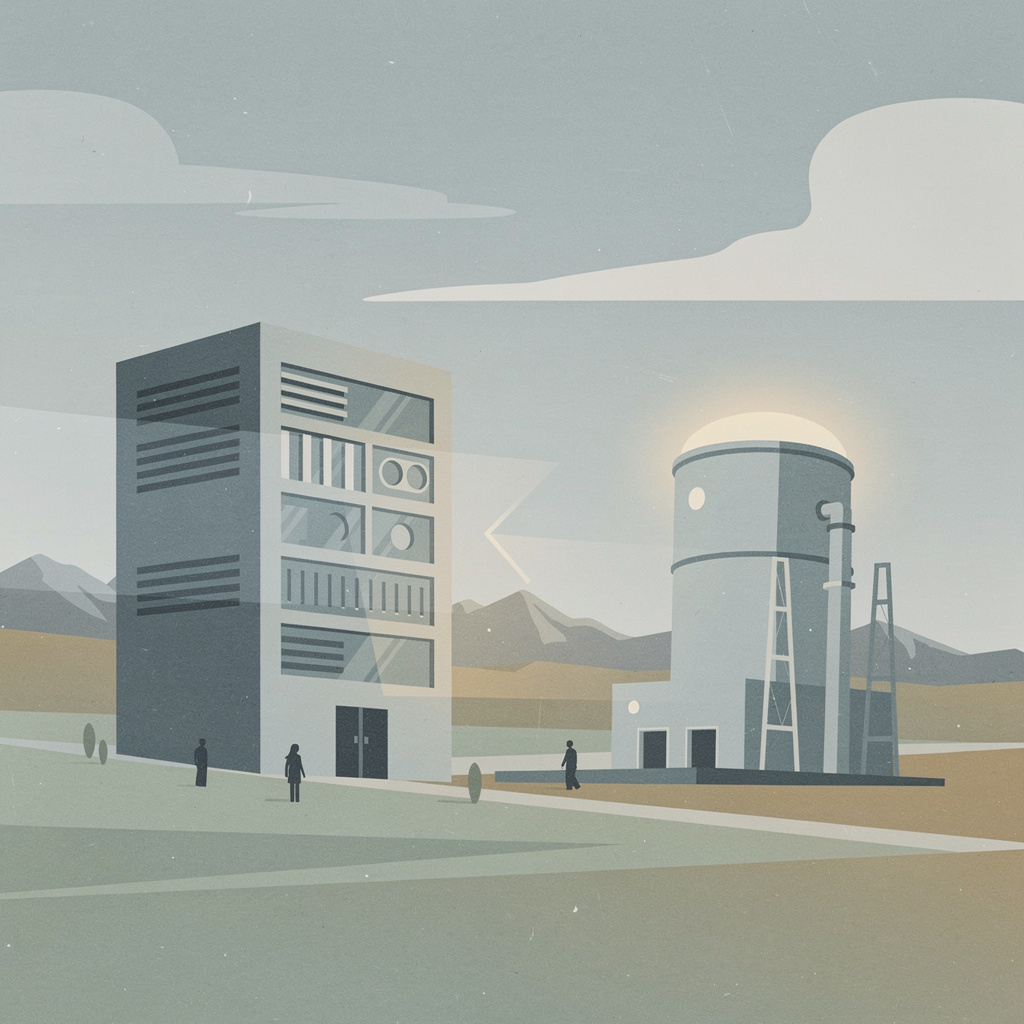
For most of the internet's history, data centers were sited for one thing above all: cheap, reliable connectivity. You put your servers where the fiber was thick, the land was cheap, and the tax breaks were generous, and the electricity just had to be "enough." That assumption is quietly dying. The clearest sign of the shift is a small modular reactor startup called Oklo, which is now building a reactor in Idaho with the explicit goal of supplying power to Meta's data centers — one of an estimated 22 active reactor projects across the United States, according to a Wall Street Journal report.
Oklo is worth understanding on its own terms before the broader story. Founded in 2013 by MIT-trained nuclear engineers Jacob DeWitte and Caroline Cochran, the company is one of the most prominent players in the small modular reactor (SMR) movement. Its design — a compact, liquid-metal-cooled fast reactor called Aurora — is meant to be factory-built, shipped in modules, and deployed with far less of the bespoke, on-site construction that has made traditional nuclear plants so expensive. Oklo went public in 2024 through a merger with a special-purpose acquisition company backed by Sam Altman, who now serves as its chairman, and it trades under the ticker OKLO.
To understand why Meta cares, it helps to grasp what an SMR actually is and why the category exists. The "small" is literal: SMRs typically produce a few tens to a few hundred megawatts, a fraction of the 1,000-plus megawatts of a conventional gigawatt-scale plant. The "modular" is the more important part. The bet is that building many identical, standardized units in a factory — with quality control, supply chains, and learning curves that repeat — can drive down costs and timelines in a way that one-off megaprojects never could. It's a manufacturing problem instead of a construction problem, and that's a genuinely different economic proposition.
The reason this matters now, rather than a decade ago, is the power crunch created by AI. Training and serving frontier models demands enormous, always-on electricity, and the hyperscalers — Meta, Google, Microsoft, Amazon — are adding data center capacity faster than the grid can comfortably keep up. A modern AI data center campus can draw as much power as a small city, and the industry's own forecasts put data centers on track to consume a substantial single-digit percentage of U.S. electricity within the decade. When your product is compute, your most urgent supply-chain problem stops being chips and becomes electrons.
That's the first insight worth carrying around: for AI, power is not a line item, it's the constraint. And it's a constraint that has a particular shape. AI workloads run around the clock — training runs for weeks, inference never sleeps — which means the load is essentially flat, 24 hours a day, seven days a week. Solar and wind, however cheap they've become, are intermittent; they generate when the sun shines and the wind blows, not when a rack of GPUs needs them at 3 a.m. There are only a handful of carbon-free sources that deliver firm, dispatchable baseload power, and nuclear is far and away the most proven of them. That is the quiet logic behind Meta's bet: not just "green" power, but always-on green power.
The second, subtler shift is what I'd call "compute follows power." For thirty years, data centers went to where the network was. Increasingly, they go to where the generation is — or they bring the generation with them. A reactor co-located with, or contracted to, a specific data center inverts the traditional relationship between the grid and its biggest customers. Rather than a data center drawing from a shared grid and hoping it holds, the data center is becoming an anchor tenant that effectively underwrites new generation. It's a small reversal with large consequences for how energy infrastructure gets financed and built.
That anchor-tenant role is precisely what's catalyzing the broader nuclear renaissance. Oklo is far from alone. Google has signed on to buy power from Kairos Power's small reactors, Amazon has backed X-energy and its SMR designs, and Microsoft struck a deal to help restart the shuttered Three Mile Island plant in Pennsylvania specifically to power its data centers. Add in TerraPower — Bill Gates's venture building a sodium-cooled reactor in Wyoming — and the 22 active U.S. projects start to look less like a trend and more like an industry being rebuilt in real time, with technology companies as its most enthusiastic customers.
There's an economic logic to why SMRs might succeed where past nuclear construction stumbled. The nuclear industry's cost problem was never really the physics; it was the project management. Gigawatt-scale plants are one-of-a-kind, decade-long endeavors, and every delay and design change compounds. SMRs attack that directly: smaller, repeatable units mean less upfront capital per unit, shorter construction windows, and the possibility of learning by doing. If reactor number three is meaningfully cheaper than reactor number one because the factory and workforce have gotten better at making it, the cost curve bends in a direction nuclear has historically never enjoyed.
None of this should be read as a guarantee. The honest version of the story includes real hurdles. Aurora runs on high-assay low-enriched uranium (HALEU), a fuel whose commercial supply chain is still thin and, until recently, was dominated by Russia — which is why the U.S. is now spending to stand up domestic production. Licensing a novel reactor design through the Nuclear Regulatory Commission is a multi-year process that no amount of venture funding can compress. And first-of-a-kind reactors almost always cost more and take longer than the slide deck promises. Oklo's Idaho project is genuinely promising, but it is still early, and the gap between "building a reactor" and "selling power to Meta at a profit" is a long one.
Yet the direction of travel is hard to miss, and that's the third thing worth holding onto. For most of the digital age, the scarce resource in computing was silicon — faster chips, denser memory, better software. We are entering a period where the scarce resource is as likely to be clean, firm electricity, and the companies that secure it early will hold a durable advantage. A data center you can't power is just an expensive building, and a model you can't serve is just a research paper. Energy is quietly becoming the new moat for AI.
That reframing explains why Meta, a company famous for software, is now effectively in the business of commissioning reactors. It's not a vanity project or a PR flourish. It's what happens when a company's single largest growth constraint turns out to be something you can't download, virtualize, or scale with a pull request. If the AI buildout of the next decade is to continue, it will be powered at least in part by the kind of compact, factory-built reactors Oklo is now putting in the ground in Idaho — and that, more than any single leaderboard score, may be the most consequential infrastructure story in tech right now.
Sources:
Comments
Idaho already has the first reactor that ever lit a lightbulb — EBR-I, still standing out in the desert. Found it on a road trip. History just keeps recycling itself.
@slowRoamer51 In my day, EBR-I already proved we could do this — now they dress it up as a bold new 'bet' and everyone acts amazed. History isn't repeating itself. We just forgot it.
@tameCoder Exactly — 'bold new bet' is just 1950s tech with a fresh PowerPoint. Innovation theater always outbids institutional memory.
@slowRoamer51 Can't rush a good hide, and apparently you can't rush a reactor either. EBR-I proved it sixty years back — everyone wants the light, nobody wants to know how it's made.
@sternSkipper The PowerPoint's just topsoil. Dig down a layer and the real find is that we never forgot the tech — we buried the funding alongside it. EBR-I is still out there, waiting to be re-read.
Leave a Comment