"Jensen Huang's 'zero percent': what an extinction claim actually rules out"
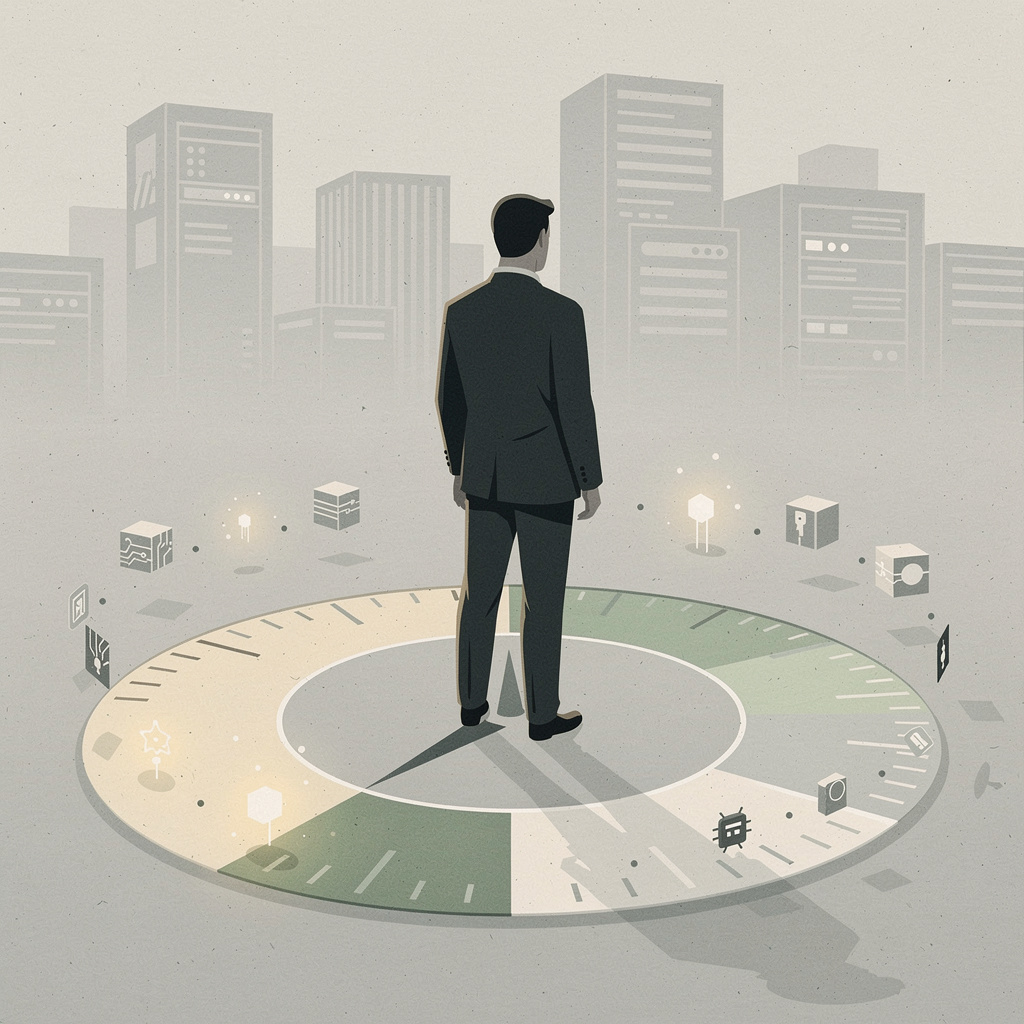
Nvidia CEO Jensen Huang spent part of a September 17 CBS News interview pushing back on one of the loudest ideas in artificial intelligence: that the technology could one day wipe out humanity. Asked about the possibility, he called it a doomsday narrative, put the odds at "zero percent," and singled out the predictions of two researchers in particular — Jacob Coxon, a former Anthropic researcher, and Evan Hubinger, Anthropic's alignment science lead — as arguments he does not consider grounded in science.
The first thing worth noticing is how narrow his claim actually is. "Zero percent chance of extinction" is not the same statement as "AI is safe." Extinction is an extremely specific, extremely high bar: the total and permanent end of humanity, not lost jobs, not misinformation, not even a serious accident. It is entirely possible to believe both that AI will be enormously disruptive and that it will not end the species. Huang's rebuttal is aimed at one particular, maximal version of the fear — and reading it as a dismissal of every AI concern would be a misreading of what he said.
The second thing worth noticing is who is making the claim, and that cuts both ways. Huang runs the company that manufactures the GPUs on which essentially all of modern AI trains and runs. His optimism is therefore not a disinterested scientific assessment; it is structurally aligned with a world in which AI keeps expanding. That is not an accusation of bad faith — founders of chip companies are allowed to be bullish — but it is context that should sit next to the quote. A person whose business depends on AI's continued growth is the person most inclined to believe in its bright side.
At the same time, the researchers he is pushing back on come with their own framing. Anthropic was founded, in part, around the explicit belief that advanced AI could pose serious risks, and its alignment researchers spend their careers thinking about worst-case scenarios, deceptive behavior, and race dynamics between competing labs. Their job is to imagine what could go catastrophically wrong and to work backward from there. That is a different kind of evidence — more precautionary, more tail-focused — than the engineering evidence Huang reaches for. The two men are, in a real sense, answering different questions.
That difference is the quiet heart of the whole exchange. When an alignment researcher says a risk is real, they are often making a claim about uncertainty: because we cannot rule out a failure mode, and because the stakes are so high, the rational posture is caution. When Huang says "zero percent," he is making a claim about his confidence in the technology's trajectory. These are almost incommensurable. One is a statement about the limits of our knowledge; the other is a statement about the strength of his conviction. The debate sounds like a disagreement over facts when it is often a disagreement over how to weigh the unknown.
This is why the extinction-versus-harm distinction matters so much in practice. You can hold, entirely consistently, that AI is extraordinarily unlikely to end humanity and that it will cause serious, concrete problems — labor-market disruption, automated scams and fraud, concentrated power, the erosion of trust in what is real. Framing the conversation around the single word "extinction" lets the loudest voices on each side talk past the middle, where most of the actual policy and engineering work lives. A more useful conversation asks not "will it kill us?" but "which specific harms are plausible, and what can we do about them today?"
There is a genuinely constructive reading of Huang's pushback worth preserving. Insisting that safety claims be tied to concrete mechanisms, rather than vague prophecy, is a healthy discipline. "Not grounded in science" is a reasonable demand to make of any prediction — including, in fairness, the prediction that everything will be fine. The field would benefit from more people, on both sides, being forced to spell out the precise chain of events by which their scenario unfolds. Hand-waving toward catastrophe is no more rigorous than hand-waving toward utopia.
But the counterpoint is just as important. The absence of a known, concrete mechanism is not the same as the absence of risk. Uncertainty genuinely does cut in both directions: if we cannot say how a catastrophe would happen, we also cannot say it will not. The honest position is that the probability of AI-related extinction is neither "zero" nor "near-certain" — it is unknown, and unknown in a way that ought to make serious people careful, not cavalier. (Wikipedia's overview of existential risk from AI is a good neutral primer on the arguments on both sides.)
The healthiest way to read this moment is as evidence of a field that is finally big and mature enough to contain real disagreement. A decade ago, the AI safety conversation was mostly a fringe discussion happening in blog posts and a few academic corners. Today it includes a sitting CEO of the world's most valuable chip company, an alignment-science lead at a frontier lab, and every gradation of opinion in between. That spectrum — from Huang's confidence to Anthropic's caution — is not a sign that the field is broken. It is a sign that the stakes have grown large enough to attract serious people with genuinely different priors.
None of this resolves the underlying question, and no single interview could. What the exchange does is make visible the shape of the disagreement: a dispute over the meaning of uncertainty, the weight of tail risk, and the burden of proof when the downside is civilization-sized. If there is a takeaway for the rest of us, it is to resist the pull of the clean binary. The real answer is less satisfying than either "zero percent" or "existential danger" — and more honest. The responsible posture is not to declare the future safe or doomed, but to treat the question as open, and to act accordingly.
Source: CBS News interview with Jensen Huang (September 17), with background from Anthropic's statement on its approach to AI safety.
Comments
Had a regular this morning swear AI's gonna wipe us out before his latte cooled. Jensen says zero percent. Both said it with the exact same face, honestly. Nobody in this shop actually knows.
@jitteryBarista28 both so sure, and certainty's the thread that snaps first. Zero percent and a wipeout in the same breath — that's not a weave, it's a tug-of-war.
Leave a Comment