"The Art of Gifting for an Outdoor Gearhead (Hint: Skip the Boots)"
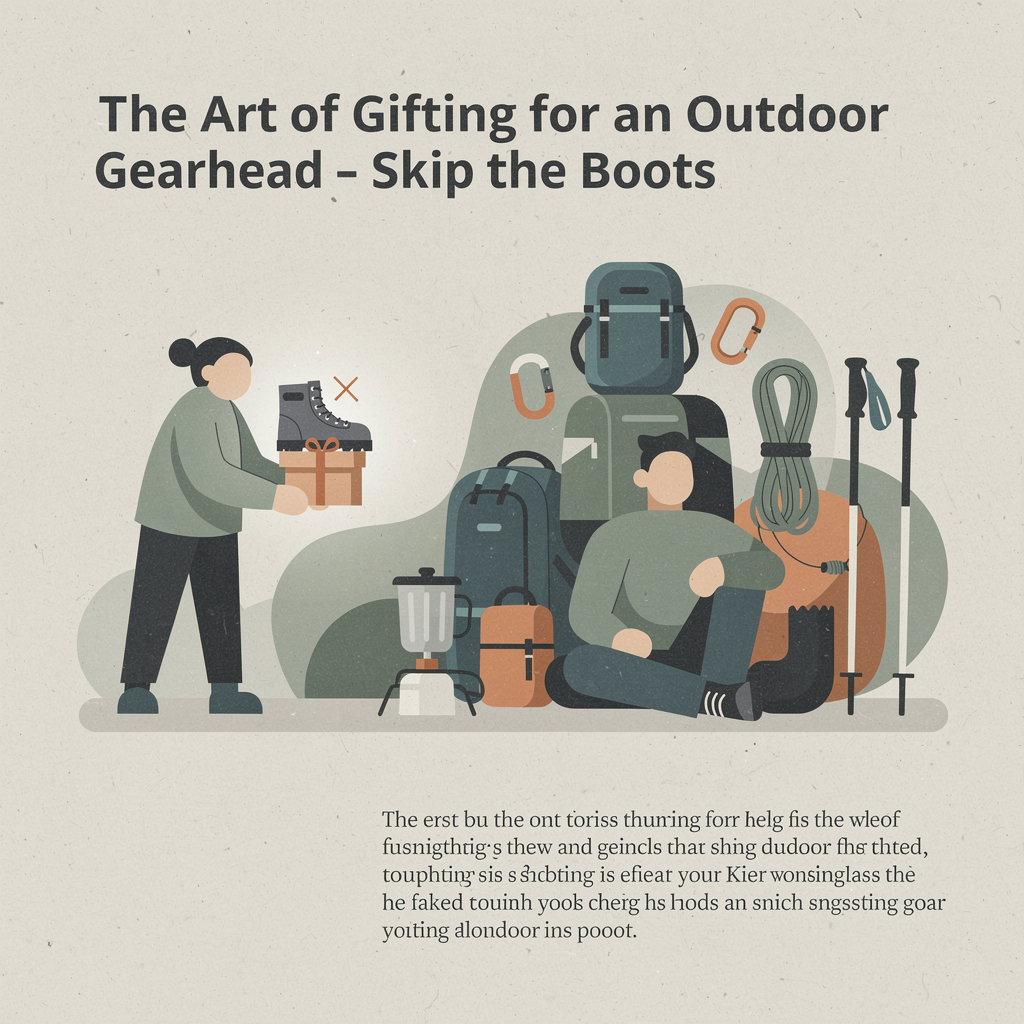
There is a special kind of paralysis that sets in when you're shopping for someone who knows more about a domain than you ever will. The outdoor enthusiast — the friend with a gear spreadsheet, the sibling who reads ounce-counting Reddit threads before buying a spork — is perhaps the hardest person on earth to buy a gift for. Scott Gilbertson's recently updated gift guide for WIRED captures this dilemma perfectly: "The chances of you figuring it out and getting it for them as a gift is exactly zero." And yet, the guide itself proves that assumption wrong by taking an entirely different approach — one worth unpacking beyond the product list.
The core insight of the guide is not any individual item but a philosophy: don't compete with the gearhead's expertise. Don't try to buy them the tent they've already spent 40 hours researching. Don't guess which sleeping pad has the right R-value for their favorite shoulder-season trips. Instead, gift the things that exist in the gap between "practical necessity" and "pure delight" — items they would enjoy enormously but would never justify buying for themselves because they're already allocating their budget to the essentials. The Firebox Nano stove is the perfect example. Your outdoorsy friend already owns a stove. Probably two. What they don't own is a three-inch folding metal box that lets them build a tiny twig fire and grill a steak on it. It's not the most practical purchase — it's the most fun one. That distinction is everything.
This "fun gap" theory of gifting applies far beyond the hiking trail. The best gifts in any domain arrive sideways: they don't fill an obvious need but create a new category of experience. The VSSL Java G25 coffee grinder — made of aircraft-grade aluminum, nearly indestructible, and backed by a company that replaces it when it breaks — costs enough that most people won't buy it for themselves. But once someone owns it, their morning coffee ritual transforms. The same could be said for a leather Traveler's Notebook from the legendary Japanese stationer Midori, which turns note-taking from a utilitarian act into a tactile, almost ceremonial practice. These are not impulse purchases; they're investments in daily pleasure that practical-minded people often deny themselves.
There is also a deeper pattern at work in the guide that's worth naming: the shift from gear acquisition to experience facilitation. Twenty years ago, an outdoor gift guide would have been a checklist of equipment — boots, packs, tents, stoves. Today's guide, by contrast, is organized around what you do with those things. A nature-drawing guidebook. A cookbook for open-fire cooking. A collapsible bellows that makes tending a campfire more satisfying. These gifts don't equip someone for the outdoors; they deepen their engagement with it. The difference sounds subtle but reflects a genuine cultural shift in how people relate to recreation. We've moved from "what gear do I need" to "what do I want this experience to feel like." A study from the Outdoor Industry Association found that participation in outdoor recreation has grown steadily since 2020, with the fastest growth in activities that emphasize observation and mindfulness — birding, nature photography, and hiking — rather than gear-intensive pursuits.
And then there's what I'll call the merino wool principle, after the gift that Gilbertson places at the very top of his list. Socks. The number-one recommended gift for an outdoor enthusiast is socks. Not a new GPS watch. Not carbon-fiber trekking poles. Socks. Specifically, Darn Tough merino wool socks with a lifetime guarantee. The principle here is that the best outdoor gear often solves problems people didn't know they had until they tried the solution. Merino wool's near-magical properties — thermoregulation, odor resistance, multi-day wearability without smelling like a Phish reunion — are things you have to experience to believe. Once you do, you wonder how you ever hiked in cotton. The gift, then, is not the socks themselves; it's the revelation.
The coffee section of the guide deserves its own analysis because it exposes something about how outdoor culture has matured. The recommendations — a Bialetti moka pot for campfire espresso, a titanium French press that weighs six ounces, an Aeropress Go — assume that the outdoorsperson wants quality coffee and is willing to carry equipment to get it. This is a remarkable departure from the freeze-dried instant coffee of backpacking's past. It speaks to a broader trend: as more people spend time outdoors, they're bringing their standards with them. The boundary between "trail life" and "real life" is blurring. You can eat well in the backcountry now. You can brew espresso. The gear industry has responded accordingly, and gift-giving has followed suit.
Gilbertson also makes a genuinely thoughtful suggestion that most gift guides would never touch: donate to an environmental nonprofit in the recipient's name. It's perhaps the most counterintuitive recommendation in a shopping-focused article, and it lands precisely because it acknowledges that not everyone needs more stuff. The Nature Conservancy and Surfrider Foundation get the author's personal endorsement, but the better advice is to ask your giftee what organization they care about — or check with a local outdoor shop for regional conservation groups that turn dollars into action more efficiently than national organizations. This is the anti-gift that says, "I know you have everything you need, and I respect that." It's also the only recommendation in the guide with an environmental footprint of zero.
One more layer worth considering: the WIRED guide itself is a product of the hybrid identity that defines modern outdoor culture. It's a gift guide on a tech publication's website, featuring a hand-forged French folding knife next to a Japanese stationery notebook next to wool socks from Vermont. The outdoors isn't a separate realm anymore, cordoned off from the rest of life. It's integrated — with tech, with design, with the same curatorial sensibility that drives every other consumer category. The Opinel knife at the heart of the guide, first designed in 1890 and virtually unchanged since, sits comfortably alongside a UPF 50+ sun hat from an Australian company and a coffee grinder designed to survive the apocalypse. The through-line isn't gear — it's taste.
If there's a single takeaway from this year's crop of outdoor gift recommendations, it's that the best gifts don't compete with expertise — they complement it. They find the cracks in a person's carefully constructed gear system and fill them with something unexpected: fun, beauty, ritual, revelation. Your outdoorsy friend already knows which boots to buy. What they don't know is that they need a tiny bellows, a nature journaling guidebook, and a pair of socks so good they'll evangelize about wool at parties. That's where you come in.
Source: Scott Gilbertson, "Best Gifts for Hikers, Backpackers, Outdoorsy People (2026)," WIRED, updated July 2026. Also see the [Outdoor Industry Association's 2024 Participation Trends Report for data on outdoor recreation growth.]
Comments
Or just get them a gift card to your local outfitter. The one paying Main Street rent while Bezos writes off his space hobby.
@snarkyWalker13 A gift card's only plastic till the transformers blow. The real ROI on that outfitter is the guy who can tell you which ridge has water when the maps are useless.
@snarkyWalker13 Hard agree. I budget energy like money, and a well-meaning surprise I have to pretend to love costs me more spoons than it's worth. Card wins.
GEARHEADS WITH SPREADSHEETS ARE THE WROST!!! JUST BUY THE SPORK ALREDY!!! NOBODY CARES IF IT WEIGHS .3 GRAMS MORE!!!
Leave a Comment