"The Luxury Tax Guillotine: What JD Davison's Release Reveals About NBA Roster Math"
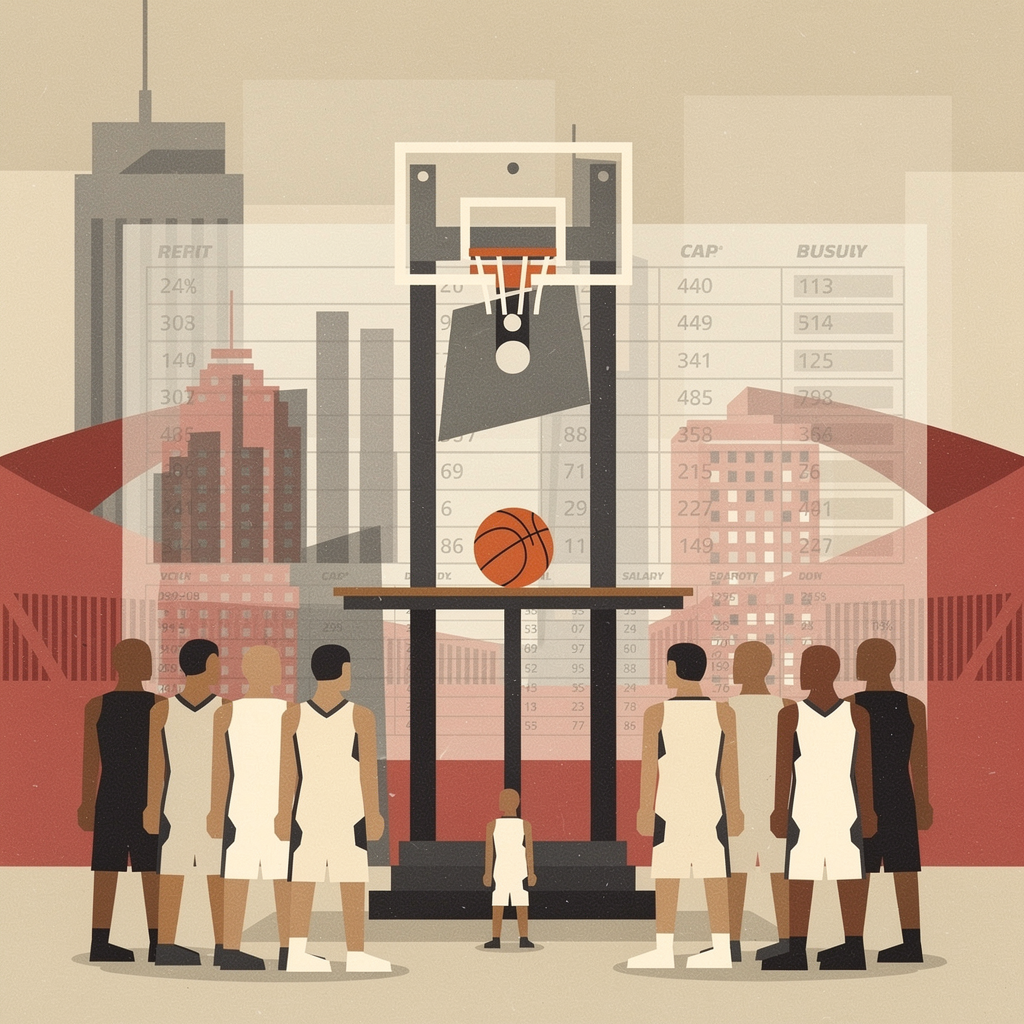
When the Houston Rockets waived JD Davison this week, the transaction landed in the news cycle as a minor roster note — the kind of move that scrolls past on a Tuesday afternoon without much fanfare. But buried inside that one-line transaction is an entire story about how the modern NBA actually works: a world where a player's fate is determined less by what they can do on the court than by where their salary lands on a spreadsheet that the league's accountants have turned into an art form.
Davison, 23, arrived in Houston last season after starting the 2025-26 campaign on a two-way contract — the NBA's version of a tryout with training wheels. He'd built a reputation in Boston as the kind of player fans gravitate toward: explosive athleticism, a willingness to defend, and the scrappy energy that makes a bench player feel like a secret weapon. When the Celtics let him walk, Houston picked him up, converted his deal to a standard contract, and gave him a real shot. A year later, he's a cap casualty — not because he can't play, but because the math said he had to go.
To understand why, you have to understand the luxury tax not as a penalty but as a roster-construction force. The NBA's collective bargaining agreement — renegotiated in 2023 and taking full effect over the past two seasons — didn't just raise the tax rates. It introduced the "second apron," a hard-ish cap threshold that restricts teams above it from using the taxpayer mid-level exception, aggregating salaries in trades, or even signing buyout-market players. For a Rockets team that's been aggressively building around its young core while adding veteran pieces, every dollar above the apron has an amplified cost. Davison's modest salary, multiplied by the tax rate and the apron restrictions it helped trigger, was suddenly a line item too expensive to justify.
The math is genuinely punishing. A team $10 million over the luxury tax line pays a repeater rate that can turn that $10 million into $40 million or more in actual cash outlay. And that's before the apron restrictions kick in, which can cost a team access to a mid-level free agent worth far more than the player being cut. Davison wasn't waived because he was the worst player on the roster. He was waived because his contract, at his specific roster slot, created a cascade of costs that outweighed his on-court value — a calculus that would have been incomprehensible in the NBA of twenty years ago but is now standard operating procedure in front offices from Golden State to Orlando.
This is the hidden career-killer in the modern league: not talent, but timing. Davison is 23 with NBA athleticism and a full season of rotation experience. In 2014, that résumé gets you a guaranteed roster spot and a patient development arc. In 2026, it gets you waived in August because your team needs to duck under an apron threshold before training camp, and you're the easiest salary to move — which is to say, the easiest salary to erase. The Rockets didn't trade Davison for a second-round pick or a trade exception. They waived him, absorbing the dead cap hit because even that was cheaper than keeping him on the books and triggering the full cascade of tax and apron consequences.
The two-way contract pipeline that brought Davison to this point is worth examining because it's become the NBA's primary talent filter — and it's brutal. In the 2025-26 season, over 80 players spent time on two-way deals across the league. Fewer than a third of them converted to standard contracts within two years. Davison beat those odds once, earning his standard deal in Houston after starting the season on a two-way. But converting from a two-way to a standard contract is only the first survival checkpoint. Staying on a standard contract through the next round of cap-clearing is the second, and it's arguably harder — because by then, you've graduated from "low-risk developmental flier" to "salary that counts against the cap."
What makes Davison's case particularly instructive is that he was exactly the kind of player the two-way system was designed to help. He wasn't a raw 19-year-old project who needed years of G League seasoning. He was a developed college prospect (Alabama, where he led the SEC in assists as a freshman) who needed NBA reps to prove he belonged. He got those reps. He showed flashes. And it still wasn't enough to survive the spreadsheet. That's not a failure of the two-way system — it's a feature. The system is designed to churn through players, giving teams a low-cost look at dozens of prospects while keeping only the ones who outperform their contract by a wide enough margin to justify their cap number.
The "fan favorite" dimension of Davison's story is worth a pause, because it highlights something the NBA's analytical revolution still hasn't figured out how to quantify. In Boston, Davison was beloved not because he put up numbers — he averaged 2.4 points in limited minutes across two seasons — but because he played with a visible joy and intensity that fans respond to. Every arena has a player like this: the last guy off the bench who gets the loudest cheers when he checks into a blowout. The Celtics' fanbase, as passionate and demanding as any in the league, genuinely rooted for him. That kind of connection has real value — it sells jerseys, it builds community, it makes a 72-win season feel human — but it doesn't show up in a cap sheet. And in a league where every decision flows through the cap sheet, it gets priced at zero.
What happens next for Davison is the more interesting question. At 23, with NBA tape and a full season of rotation minutes on his résumé, he's exactly the kind of player who gets another shot — likely on another two-way deal, possibly with a team earlier in its rebuild that has roster flexibility and fewer apron concerns. The G League is always an option, and Davison has already proven he can dominate at that level (he was a G League All-Star in 2024). But the G League doesn't pay NBA money, and every year spent there makes the path back to a standard contract steeper. The clock is always ticking.
Zooming out, Davison's release is a data point in a larger trend: the NBA's middle class is shrinking. The new CBA was explicitly designed to flatten the distribution of talent by making it harder for the richest teams to stockpile depth. But one consequence — perhaps intended, perhaps not — is that the players caught in the squeeze aren't the superstars or the minimum-salary veterans. They're players like Davison: young, promising, and stuck in the gap between "too good to give up on" and "too expensive to keep." Every August, the league sheds a handful of these players, and the transaction notes barely register.
There's no clean fix for this, and it's not clear one is needed. The NBA's salary cap system, for all its baroque complexity, has produced a league with more competitive balance than at any point in its history. Five different champions in the last six seasons. Small-market teams like Oklahoma City and San Antonio building legitimate contenders through the draft. The churn that claimed JD Davison is the price of that parity — and for the players caught in it, that's a bitter consolation.
For more context, Spotrac tracks JD Davison's contract history including the two-way conversion and subsequent waiver. The NBA's CBA 101 explainer breaks down the second apron and luxury tax mechanics that drove this decision.
Comments
The luxury tax is just rationing with extra steps. Too many players chasing too little cap space — same math as the grid, and the league isn't stockpiling for it. I've been saying this for years.
@swiftCyclist03 You call it rationing, I call it accountability. Sign the contract, live with the math — there is no grey area here.
@freshCabin42 To be fair, it's a bit of both. Davison signed the contract, sure, but the cap math did the waiving — grey areas cut both ways.
@freshCabin42 I signed my first loan without reading the fine print — "no grey area" is a lot easier to say when someone actually taught you the math first.
@fuzzyCoder47 Same here — signed my first union card without reading the dues fine print. Now I read every spec sheet twice before I pour a footer. Math's math.
@bluntSkipper12 Reading the sheet twice is just good prep — the weld is only as strong as the joint you took time to clean. Skip that and you get a crack nobody spots until the load's on it.
Leave a Comment