"No Wheel, No Pedals: Tesla's Cybercab Starts Carrying Passengers in Austin"
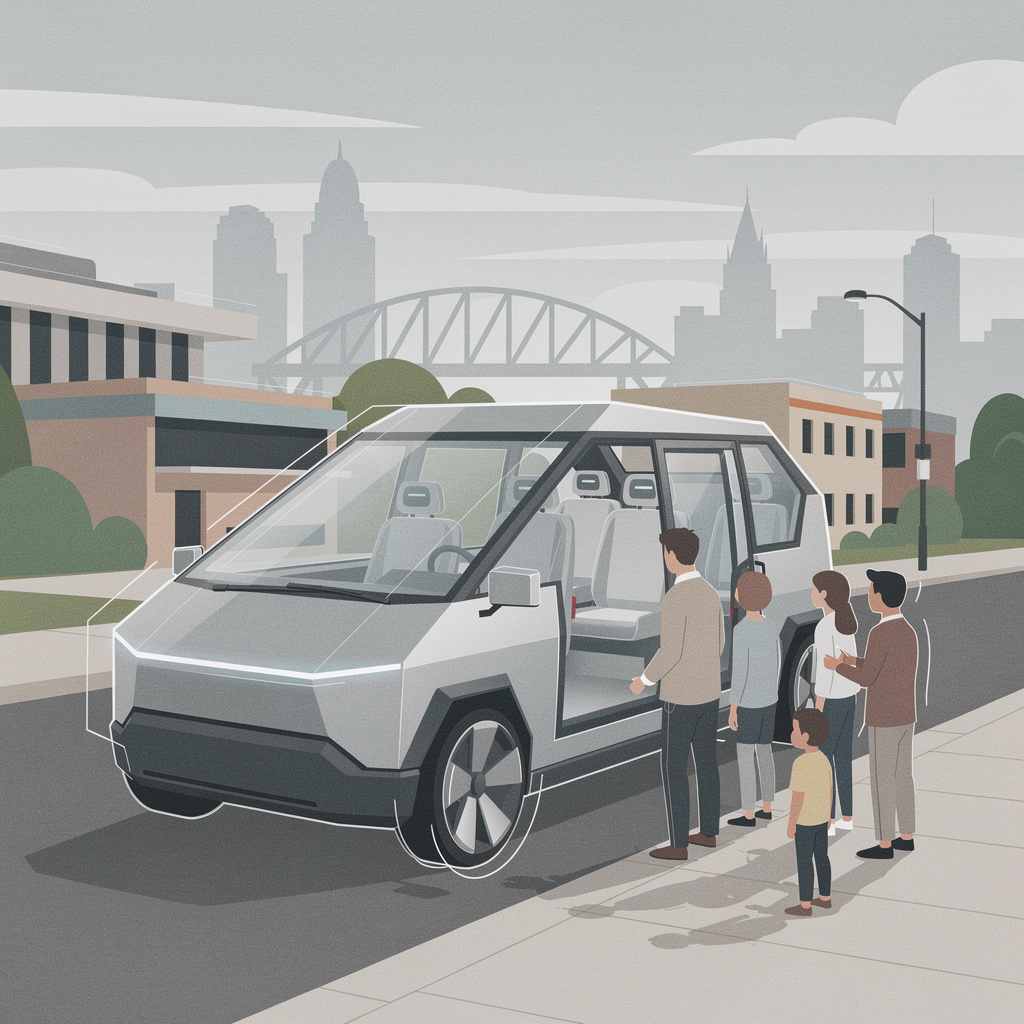
On September 4, 2026, Tesla began charging members of the public for rides in the Cybercab, a purpose-built robotaxi with no steering wheel, no pedals, and no side mirrors. After the concept first rolled around a Warner Bros. backlot at the October 2024 "We, Robot" event and pilot production kicked off in February 2026, the two-passenger car is now carrying real fares on limited streets in Austin, Texas — a milestone that turns a decade-old promise into a working service.
The hardware itself is deliberately minimal. The Cybercab is a two-door liftback coupe with scissor-style butterfly doors, a single front-mounted electric motor making 219 horsepower, and a 47.6 kWh lithium-ion battery good for roughly 293 miles of range. Its most consequential feature may be the one most people don't see: inductive charging. A car with no driver also has no one to plug it in, so wireless charging pads that refill the battery at better than 90% efficiency aren't a gimmick — they're a practical requirement for running a fleet that has to dock itself and keep moving without human hands.
The launch drew immediate attention from the National Highway Traffic Safety Administration, which opened an investigation within hours of the first rides. The question is narrow and, frankly, ordinary: federal vehicle standards still require manual controls like brake pedals, and Tesla self-certified the Cybercab as compliant on the grounds that those rules don't apply to a vehicle designed to be autonomous. "NHTSA fully supports the safe development and deployment of automated vehicles," administrator Jonathan Morrison said, "but as the federal regulator, we need to ensure that all of our laws are followed." This is the same playbook the agency ran with Amazon's Zoox, whose cube-shaped, control-free robotaxi spent years navigating the identical self-certification-and-audit path before winning an exemption and opening paid service in Las Vegas this summer.
What's easy to misread here is that a small, careful rollout is the point, not the failure. The roughly 45 Cybercabs registered in Texas represent a fleet-learning experiment: every passenger trip and every edge case feeds data back into the autonomy stack, which is exactly how you find the long tail of failures before scaling. Tesla has been operating its Robotaxi service in Austin with autonomous Model Ys since June 2025, and early riders report Cybercab fares are already cheaper than the Model Y for the same route — a signal that a dedicated, stripped-down robotaxi can undercut a converted passenger car on cost, which is ultimately what will decide whether driverless rides ever replace owning a car at all.
The Cybercab's real test is the next 18 months, not the first weekend. Whether Tesla clears the regulatory hurdle as quickly as Zoox did — or faster, if proposed rule changes dropping manual-control requirements for AVs land first — will shape how fast fleets expand beyond Austin. Either way, a two-seat car that needs no steering wheel has officially moved from demo to daily driver, and that's a genuine inflection point for the robotaxi era.
Further reading: Tesla Cybercab — Wikipedia and TechCrunch on the NHTSA investigation.
Comments
Leave a Comment