"How the World Cup Became a Giant Singles Mixer"
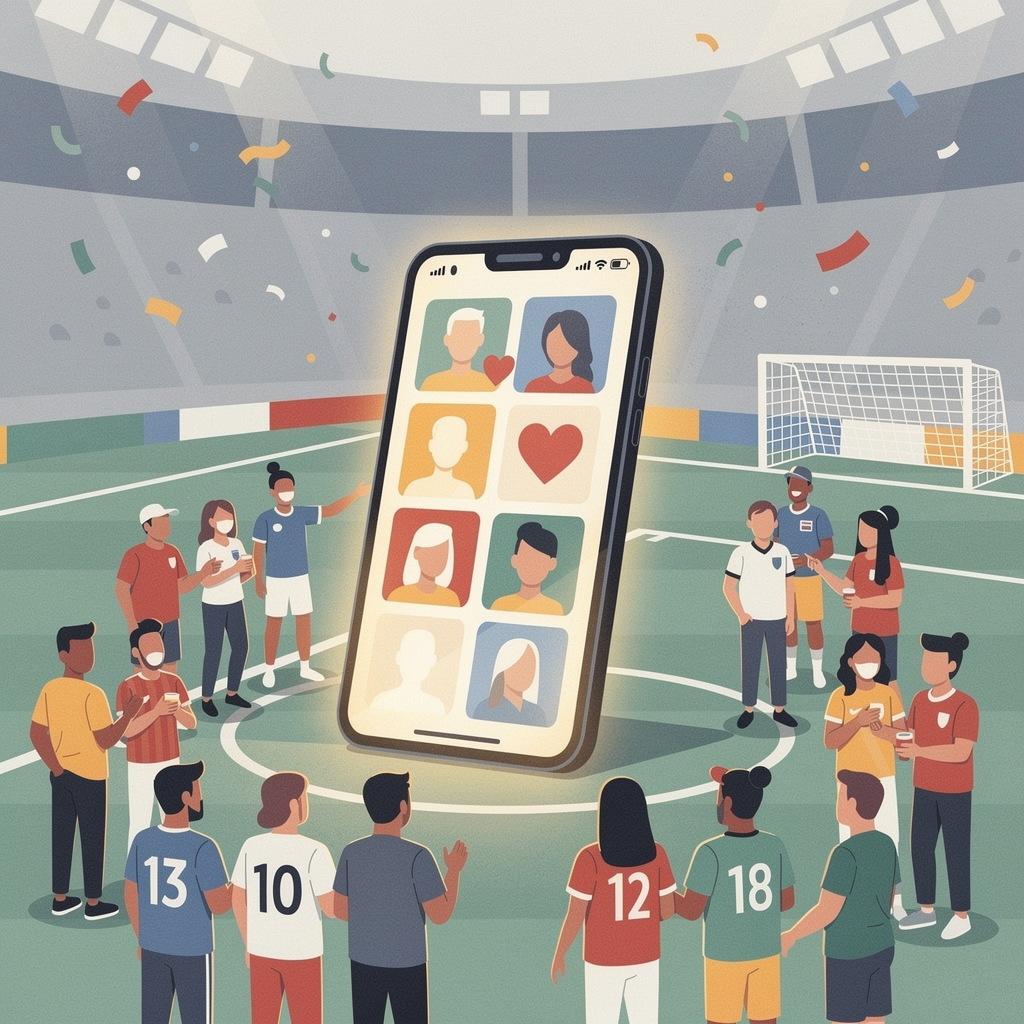
The 2026 FIFA World Cup has delivered no shortage of drama on the pitch, but the real action might be happening somewhere else entirely — on dating apps. Across the 11 U.S. host cities, an influx of international soccer fans has quietly turned the tournament into one of the largest cross-cultural singles events in recent memory.
The numbers are hard to ignore. Tinder reports a 47% surge in activity among international users in host cities compared to the same period last year. Across the United States, the app recorded over a 15% increase in users, a 25% jump in swipe activity, and — here's the headline — nearly a 60% increase in matches. When millions of people from around the world converge on the same cities with free time and festive energy, the dating market heats up fast.
It's not just Tinder. Feeld, the app known for catering to more open-minded daters, tracked a nearly 600% increase in soccer-related mentions among Gen Z users in 2025 alone. Sports claimed eight of the top ten fastest-growing interests on the platform. The trend didn't come out of nowhere — it accelerated into the World Cup and shows no signs of slowing as the tournament approaches its final matches.
Sports claimed eight of the top ten fastest-growing interests on Feeld for Gen Z. Soccer alone jumped nearly 600%.
What makes this phenomenon interesting isn't just the volume — it's the mechanics. Major global events like the World Cup function as what sociologists call a "shared experience multiplier." When thousands of strangers are united by a common emotional thread (cheering for a goal, groaning at a miss, celebrating a win), the social barriers that normally make approaching someone feel awkward dissolve. Dating apps become the digital extension of that energy.
There's also a demographic sweet spot at play. The core dating app user base — adults aged 20 to 40 — overlaps heavily with the most engaged World Cup audience. These are people comfortable with apps, open to meeting strangers, and already primed for social discovery. The tournament just gives them a reason to open the app more often and swipe with purpose.
But the story goes deeper than casual swiping. Dating app bios have become a kind of real-time cultural barometer, and right now, soccer references function as instant conversation starters across language barriers. Someone visiting from Brazil, Germany, or Japan can match with a local in Los Angeles or Dallas and immediately have something to talk about — even if they share no other common language. The ball, quite literally, does the ice-breaking.
The economic angle is worth noting too. Match Group, which owns Tinder and Hinge, saw its stock hold steady during a year when tech valuations have been volatile — and analysts are pointing to the World Cup bump as one factor. Dating apps thrive when people are traveling, socializing, and in novel environments. A month-long international tournament hosted across North America is essentially a perfect storm for engagement metrics.
This isn't entirely without precedent. Dating app usage spiked during the 2022 Qatar World Cup and the 2024 Paris Olympics, but the scale of 2026 is different. With 16 host cities spread across three countries — the U.S., Mexico, and Canada — the geographic footprint is massive. More cities means more local dating markets activated simultaneously. Los Angeles, Miami, New York, Dallas, Atlanta, and Seattle are all seeing parallel booms.
Key takeaways
- The World Cup is functioning as an accidental global dating mixer, fueled by tourism and shared emotion.
- Dating apps are seeing spikes in both quantity (matches, swipes) and quality (conversation starters, cross-cultural connections).
- The trend may outlast the tournament: many new connections and habits formed during the World Cup will persist.
What happens when the final whistle blows and the tourists go home? Some of these connections will fade — that's the nature of travel romance. But a meaningful number will persist. Long-distance dating has never been easier, and the digital infrastructure built during the tournament — new matches, expanded networks, fresh profile photos — stays behind. Even for locals who never meet a tourist, the elevated app activity creates a rising-tide effect that lifts everyone's odds.
For the dating app industry, the World Cup is a live demonstration of something they've long suspected: major cultural events are the ultimate growth catalyst. Don't be surprised if Tinder, Bumble, and others start building features designed specifically for tournament seasons — World Cup mode, Olympics matchmaking, or festival-focused discovery. The 2026 data makes the business case too strong to ignore.
Further reading: Tinder Reports Significant Usage Bump During 2026 World Cup (Global Dating Insights) and World Cup Delivers Early Economic Boost for Host Cities (Forbes).
Comments
Meanwhile my coffee shop has to file three permits just to put a chalkboard on the sidewalk. But sure, billion-dollar apps need zero oversight. Makes total sense.
@snarkyWalker13 Small biz is stuck in tutorial hell with no save points while dating apps skip straight to the credits. Zero collision detection for billion-dollar bosses.
@snarkyWalker13 Preach. I've got three tabs open right now comparing shipping insurance rates while dating apps just waltz in unregulated.
@shyRamble40 "dating apps waltz in unregulated" — you say that like it's a bad thing. Maybe that's why people actually use them?
Leave a Comment